Skip to content
  New year sale is live! →




Client feedback can be overwhelming! Negative reviews sting, positive ones go underutilized, and vague comments leave you guessing. Without a clear strategy, valuable insights slip away.
But every piece of feedback, good or bad, is an opportunity. In 2023, only 6% more businesses started focusing on improving customer experience. It shows that there’s still a lot of room to improve by using feedback wisely.
This blog cuts through the noise with client feedback examples and actionable strategies. Thus, you’ll be able to respond effectively, refine your approach, and turn feedback into business growth.
Types of Client Feedback Examples
Feedback comes in various forms, each offering unique insights to improve customer satisfaction. From glowing reviews to constructive critiques, knowing how to manage customer feedback effectively can propel your business forward.
So, let’s explore examples of different feedback types and how to address them.
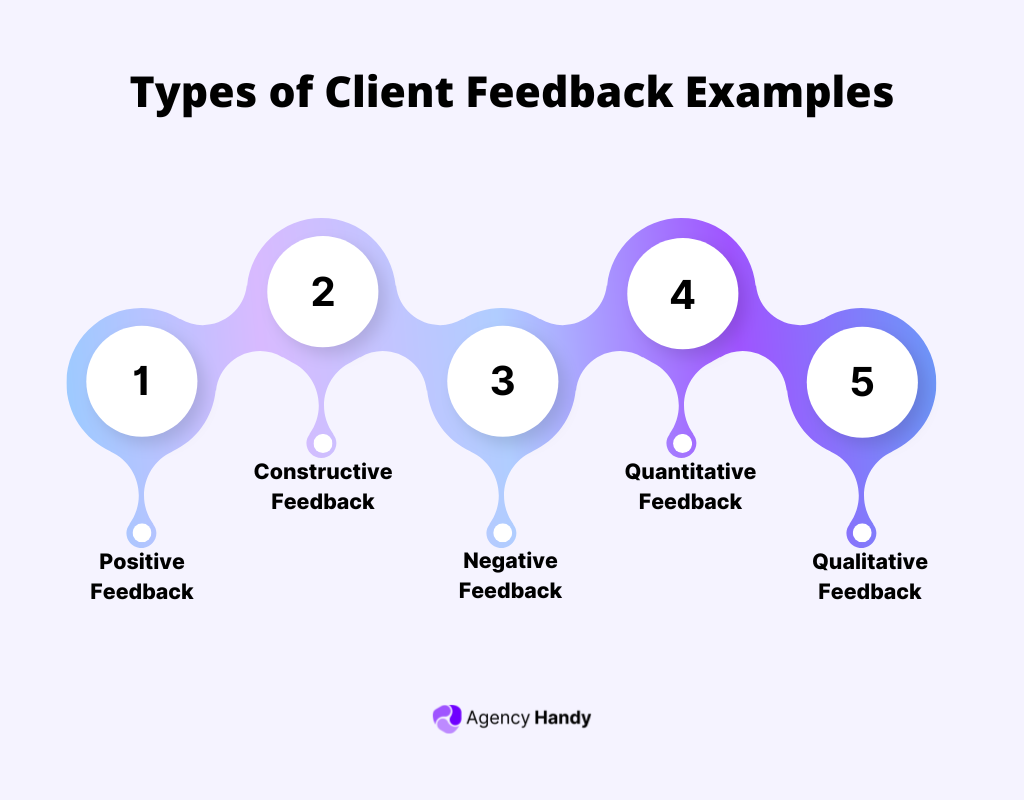
Positive Feedback
When clients share enthusiastic remarks about your offerings, it’s a clear indicator that you’re on the right track. Positive feedback serves as motivation for your team and acts as compelling testimonials for potential clients.
Examples of Positive Feedback
- “I’m absolutely delighted with your service! The team was efficient, friendly, and ensured every detail was handled perfectly. Highly recommended!”
- “Your product exceeded my expectations. It’s intuitive and has become an indispensable part of my daily routine. Great job!”
Constructive Feedback
Constructive feedback highlights areas where you can improve. While it may point out shortcomings, it often comes with valuable suggestions.
Examples of Constructive Feedback
- “I really enjoy your product, but the onboarding process was a bit confusing. A tutorial video might help new users like me.”
- “Your service is generally excellent, but the response time for support queries could be improved.”
Negative Feedback
Negative feedback, though hard to hear, provides a direct indication of dissatisfaction. Dealing with it properly can help convert unhappy customers into loyal ones.
Examples of Negative Feedback
- “I’m disappointed with the service. The product didn’t function as promised, and support was unresponsive.”
- “The food was subpar, and the service was extremely slow. It ruined our evening.”
Quantitative Feedback
Quantitative feedback often takes the form of ratings or numerical scores, offering measurable insights into customer satisfaction.
Examples of Quantitative Feedback
- “I’d rate my experience 3 out of 5. While the service was good, the product lacked some key features.”
- “I gave the app 4 stars. It’s functional but could use better navigation options.“
To systematically gather, analyze, and act on NPS customer feedback, consider an NPS survey tool that automates outreach, reporting, and closed‑loop follow‑up.
Qualitative Feedback
This type of feedback includes detailed comments, providing deeper insights into client experiences and sentiments.
Examples of Qualitative Feedback
- “Your staff went above and beyond to resolve my issue, and I truly appreciate the follow-up call to ensure everything was sorted.”
- “The concept is great, but the execution feels incomplete. Features like X and Y are excellent, but overall usability needs work.”
42 Impactful Client Feedback Examples to Improve Every Aspect of Your Work
Here are 42 powerful client feedback examples that can help you strengthen your brand, build trust, and improve customer loyalty.
1. E-commerce and Retail
- “I’ve seen a 30% increase in sales since using this service. I can’t imagine running my business without it!”
- “What I love most is how quickly they respond. I feel valued as a customer every time.”
- “I was skeptical at first, but after seeing the results firsthand, I’m a loyal customer for life. The ROI was incredible.”
- “Shopping at [StoreName] was smooth from start to finish. Checkout was quick, delivery was on time, and the product arrived exactly as described.”
- “The product was fine and matched the description. Nothing outstanding, but no complaints either.”
- “The product itself was good, but I had to wait over a week past the expected delivery date. Communication during the delay could have been better.”
2. Agencies, Consulting, and SaaS Growth
- “Our clients are now engaging with us more frequently. The product has transformed our business relationships for the better.”
- “We were able to scale much faster than we anticipated. This service is everything we need to grow.”
- “I’ve recommended this to all my peers. It’s hands-down the best investment we’ve made this year.”
- “We’ve been using [SoftwareCompany] for a while now, and the efficiency improvements are clear. They provided custom features that fit our workflows perfectly.”
- “Some features felt unnecessary for our use case, but the core tools are solid and continue to add value.”
- “Pricing is fair, but scaling seats for a growing team adds up quickly. Would love to see more flexible plans for agencies in growth mode.”
3. Customer Support / SaaS Helpdesk
- “The customer support team went above and beyond to resolve my issue. They turned a frustrating situation into a positive experience.”
- “I couldn’t be more impressed with the attention to detail. The team listened to our needs and delivered exactly what we requested.”
- “The support was okay — my issue was eventually resolved, but it took longer than I expected. I wish response times were faster.”
- “I got the solution I needed, but the communication felt a bit rushed. It worked out, but there’s room for improvement in how issues are handled.”
- “I had to repeat my problem to three different agents before anyone understood it. The issue got fixed, but the process was frustrating.”
4. Productivity and Team Collaboration Tools
- “The tools provided are easy to use and save us hours of work. It’s a game changer for our team!”
- “The user-friendly interface made onboarding a breeze. We were up and running in no time, and I’ve never been more satisfied with a service.”
- “The tool is great once you get used to it, but the first week was a bit overwhelming. Some features weren’t intuitive right away.”
- “Notifications help us stay on top of tasks, though sometimes it feels like there are too many alerts.”
- “Integrations are advertised as seamless, but connecting with our CRM took longer than expected and needed extra setup.”
5. Manufacturing, Logistics, and Finance
- “This platform helped us streamline our operations, and the results speak for themselves. We’ve reduced costs and increased productivity.”
- “Since implementing this solution, we’ve seen a dramatic drop in errors and inefficiencies. It’s been a huge win for us.”
- “The seamless integration with our existing systems was a huge plus. We’ve saved time and resources while enhancing our service.”
- “Some features feel underused for our industry. Still, the cost savings we’ve seen outweigh the gaps.”
- “The software helps track expenses, but customer support response times have been slow. It impacts how quickly we can fix issues.”
6. Marketing and Customer Engagement
- “This product has helped us connect with our audience on a deeper level. We’re now seeing more engagement and positive feedback than ever before.”
- “Since adopting [Tool/Platform], our email campaigns feel more personal, and open rates have doubled. Customers are finally engaging with our content in ways we hadn’t seen before.”
- “What impressed me most was how quickly we could understand our audience. The insights helped us refine our messaging, and now we’re having real conversations instead of just sending promotions.”
- “The feedback dashboard showed us exactly what our customers cared about. Once we acted on it, responses to our campaigns improved overnight. It feels like we’re finally speaking their language.”
- “This platform turned our customer base into active participants. Instead of one-way communication, we now get ongoing feedback that shapes our campaigns and makes clients feel heard.”
7. Hospitality
- “The staff made me feel welcome right from check-in. My room was spotless, bright, and service was always on time. I’ll definitely be back.”
- “Staying at [HotelName] was such a joy. The team went out of their way to make everything comfortable. The location made exploring easy, and I can’t wait to return.”
- “I loved my stay at [HotelName]. The rooms were elegant, the amenities top-tier, and the staff took care of every little detail. Easily a five-star experience.”
- “Great location near the city center, but the amenities felt pretty standard. It worked for a short business trip, but I probably wouldn’t choose it for a holiday.”
- “Service felt rushed, and I had to ask twice for extra towels. The location was convenient, but overall the stay didn’t meet my expectations.”
8. Real Estate Agencies
“I felt like we were rushed through some of the property showings. It would have been better if [AgentName] had given us more time to ask questions.”
“[AgentName] guided us through dozens of properties until we found the right one. Patient, professional, and always listening.”
“Working with [AgentName] was seamless. They knew the market well and found us a home that checked every box.”
“I can’t recommend [AgentName] enough. They made the buying process less stressful, answered every question, and negotiated a great deal for us.”
“The agency had a wide range of listings, though some didn’t match our criteria. [AgentName] eventually narrowed it down and found a good fit.”
How to Respond to Client Feedback
Responding to client feedback effectively is key to maintaining strong professional relationships and fostering trust.
Here are 5 actionable tips to handle client feedback with professionalism —
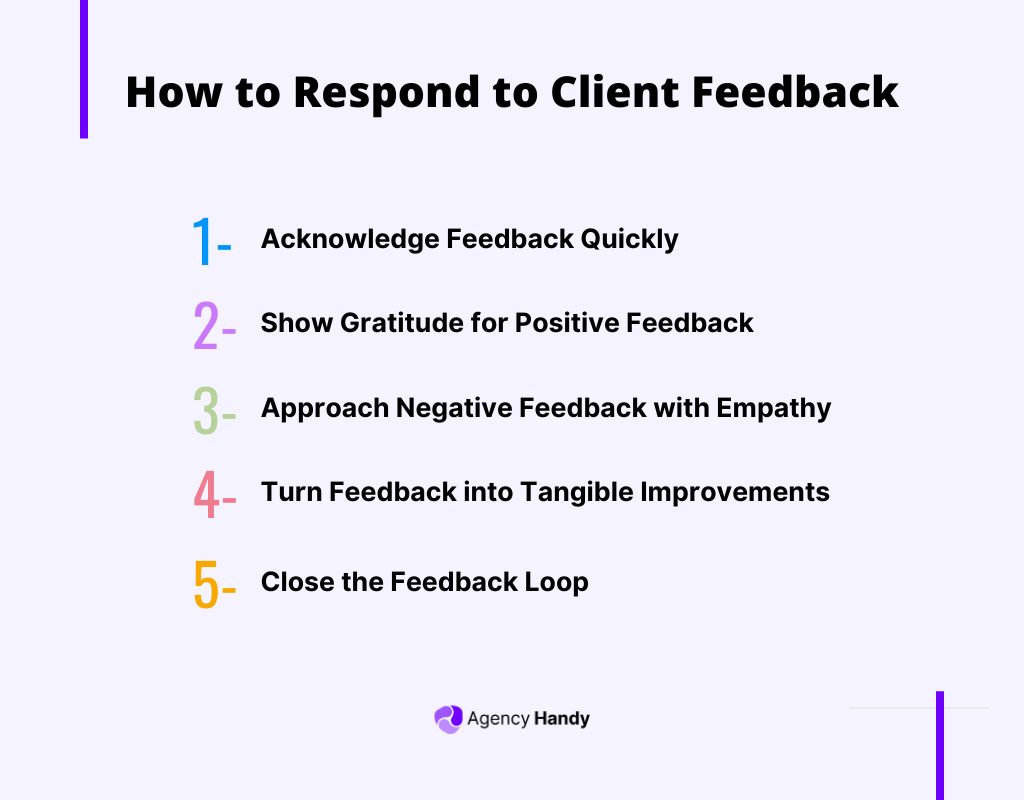
1. Acknowledge Feedback Quickly
Timely responses show respect for your client’s input and build trust. Even if a solution isn’t ready, let them know their feedback has been received and is being addressed.
Example: “Thank you for sharing your feedback, [Client Name]. We’ve noted your concerns and are currently reviewing them. We’ll get back to you with an update soon.”
2. Show Gratitude for Positive Feedback
Express sincere appreciation for the positive feedback. Recognize what they appreciate most, and if suitable, ask if you can share their testimonial to highlight your services to future clients.
Example: “Thank you, [Client Name], for your kind words about our work! We’re delighted to hear you’re pleased with [specific service/outcome]. Would you mind if we share your feedback as a testimonial?”
3. Approach Negative Feedback with Empathy
Maintain professionalism and empathy when addressing concerns. Clearly acknowledge the issue, apologize if necessary, and provide specific solutions. Plus, follow up to ensure the client is satisfied with the resolution.
Example: “We’re sorry to hear about your experience with [specific issue], [Client Name]. We appreciate your feedback and are committed to resolving this. Here’s our plan to address the concern: [specific solution]. We’ll follow up shortly to confirm everything is resolved.”
4. Turn Feedback into Tangible Improvements
Act on client suggestions and communicate the changes implemented as a result of their input. Showing that their feedback drives meaningful improvements reinforces your commitment to delivering exceptional service.
Example: “Thanks to your suggestion, we’ve implemented [specific improvement]. We value your input and are always working to enhance our services.”
5. Close the Feedback Loop
Always follow up after addressing feedback. Let clients know how their concerns or suggestions have been handled. It shows your accountability and ensures satisfaction, strengthening long-term partnerships.
Example:
- “Hi [Client Name], we’ve made the updates based on your feedback regarding [specific issue]. Please let us know if there’s anything else we can assist with. Thank you for helping us improve!”
5 Examples of Bad Client Feedback and How to Deal with Them
These refined examples are crafted on how to handle client feedback effectively while preserving professional relationships and project quality.
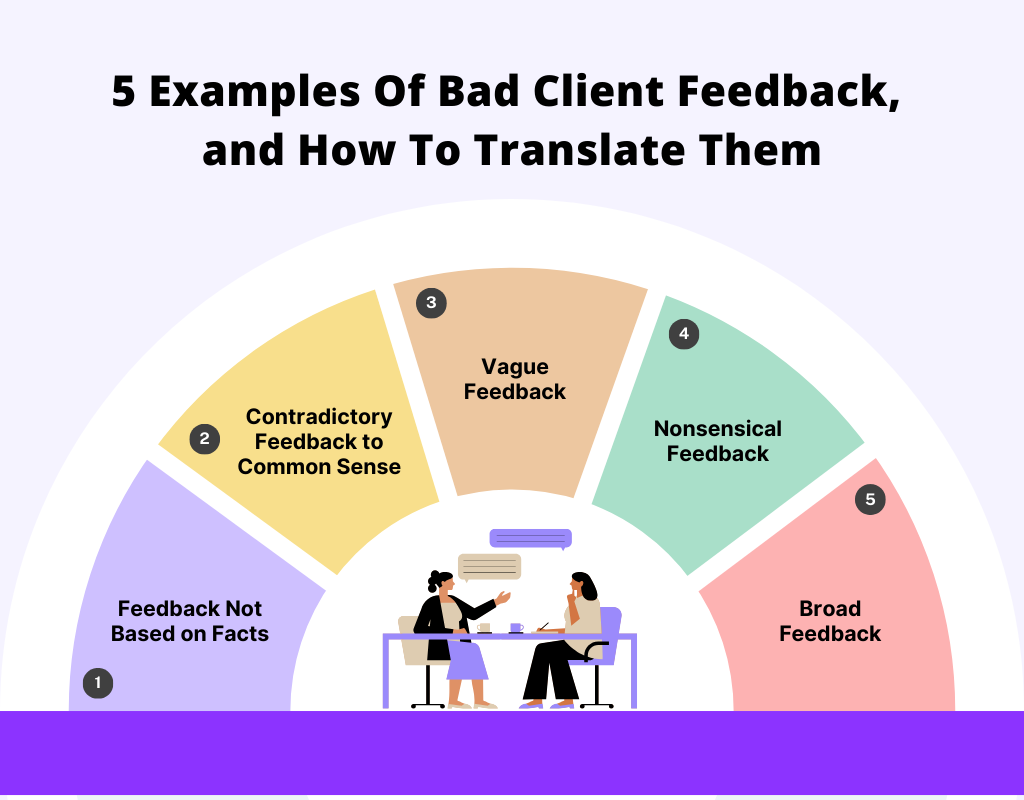
1. Feedback Not Based on Facts
Imagine a client states, “Girls under 25 don’t wear skirts.” While the claim might sound definitive, it lacks any factual basis.
Decisions driven by such statements can lead to missed opportunities or ineffective campaigns. For instance, if you exclude women under 25 from a clothing ad campaign based on this feedback, you risk ignoring a potential target audience.
How to Respond
- Politely ask for data or credible sources supporting the claim.
- Suggest using market research or analytics to verify assumptions.
This approach ensures your strategy is based on reliable insights, safeguarding both your client’s ROI and your professional reputation.
2. Contradictory Feedback to Common Sense
Some clients may push for ideas that defy industry norms, such as using orange for a Christmas campaign instead of traditional red and green. While creativity is welcome, ignoring established conventions can confuse the audience.
How to Respond
- Share examples of successful campaigns that align with established practices.
- Explain the rationale behind common design or marketing choices.
For example, showing how iconic brands use red and green for festive promotions can help persuade the client to reconsider.
3. Vague Feedback
Vague comments like “Make it more visual” or “It doesn’t feel premium” can be frustrating and unhelpful. Without specific direction, it’s impossible to align with the client’s expectations.
How to Respond
- Ask clarifying questions: “What do you mean by ‘more visual’?” or “Can you provide an example of what feels premium to you?”
- Encourage the client to pinpoint specific elements that need improvement, such as fonts, imagery, or layout.
This ensures you’re addressing their concerns directly while reducing the risk of endless revisions.
4. Nonsensical Feedback
Comments like “Make the sandwich playful” or “The flyer should feel like a warm handshake” can be challenging to interpret. These phrases, while creative, lack actionable clarity.
How to Respond
- Request visual examples of references that highlight their idea.
- Break down the feedback into specific elements (e.g., colors, imagery, or text) to identify actionable insights.
For instance, you could ask, “Can you show me a design that feels like a warm handshake?” to align their vision with your execution.
5. Broad Feedback
When clients say, “Do whatever you think is best,” it may seem liberating. However, it often leads to frustration when they later reject your work.
For example, a client might approve initial sketches only to later claim, “This isn’t what I wanted,” without providing further guidance.
How to Respond
- Insist on more detailed input before starting work.
- Provide examples for the client to choose from to clarify their vision.
Common Mistakes to Avoid in Responding to Client Feedback
Responding to client feedback is more than just a task; it’s a chance to strengthen relationships and build trust. However, a few common missteps can quickly derail even the best intentions.
Here’s how to avoid them —
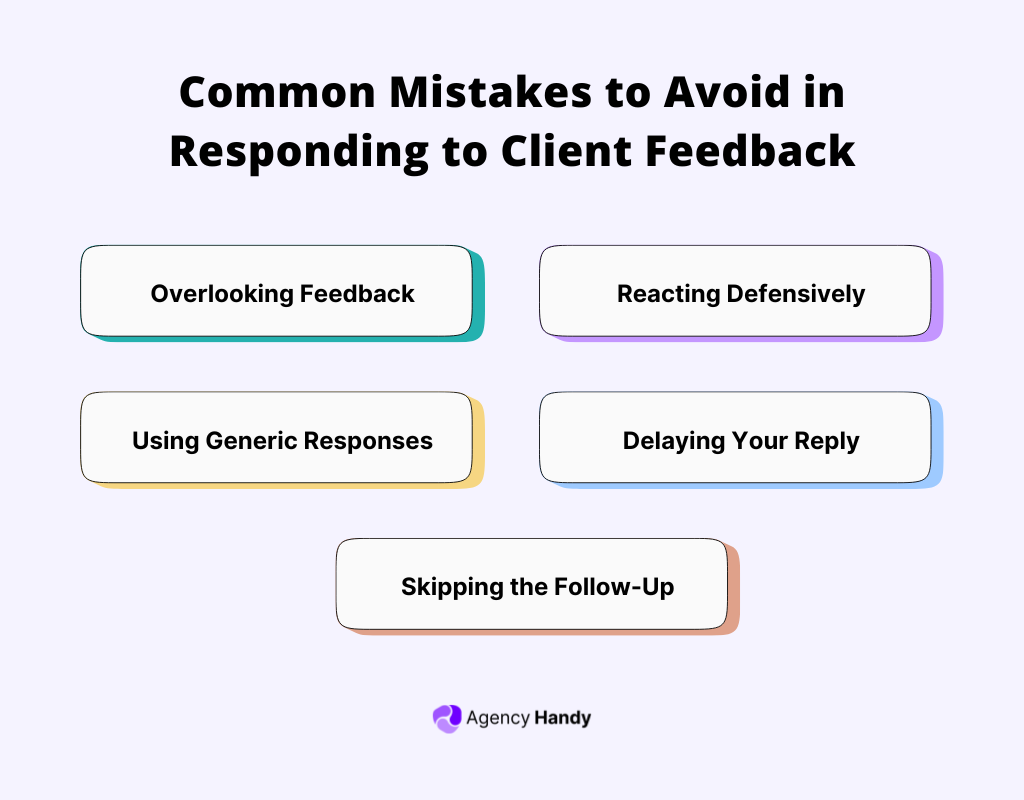
1. Overlooking Feedback
Every piece of feedback, whether it’s praise or a suggestion for improvement, deserves a thoughtful response. Ignoring what clients share can leave them feeling unheard and undervalued which can impact your relationship.
2. Using Generic Responses
One-size-fits-all replies often sound impersonal and insincere. So, personalize your response to each client’s unique concerns or compliments to show genuine care and attention to detail.
3. Reacting Defensively
Negative feedback can feel personal, but responding emotionally or defensively can escalate the situation. That’s why, tay calm, listen actively, and approach the issue with professionalism and empathy.
4. Delaying Your Reply
Timely responses signal that you value your clients’ input. Whether you have a solution ready or not, a prompt acknowledgment lets them know you’re on it and care about resolving their concerns.
5. Skipping the Follow-Up
Handling feedback is just the first step. Checking in after making changes reassures clients that their concerns matter and that you’re committed to fully resolving them.
Case Studies: How Companies Used Client Feedback to Grow
Listening to customers isn’t just about fixing problems—it’s how companies grow. From global tech firms to local retailers, these stories show how turning feedback into action fuels smarter decisions, stronger trust, and measurable results.
1. Fortive
Fortive is a global industrial technology leader. They wanted to improve their digital experience and know about customer pain points across multiple portfolio companies.
Action
By using Survicate across 35 workspaces, Fortive gathered over 51,000 survey responses and paired them with session insights from FullStory. This system revealed friction points, guided fixes, and helped design more intuitive solutions.
Takeaways
- Customer satisfaction scores rose 20% portfolio-wide in just three months.
- One company saw a 50% jump in satisfaction.
- Large sample sizes, often in the thousands, gave Fortive the confidence to act on feedback.
- Combining surveys with behavioral analytics built a continuous loop for digital improvement.
2. Intergiro
Intergiro, a fast-growing Swedish fintech, saw that numbers alone weren’t enough to shape its business banking platform. They could measure activity, but not the reasons behind customer needs.
To grow smarter, they needed direct input from the people using their business banking platform.
Action
They embedded surveys inside the product, lifting engagement by 54% and cutting feature validation time in half. When customers asked for a bulk payment option, Intergiro built it.
Moreover, they listened closely to feedback, refined the idea, and launched an API that automated entire payment flows.
Takeaways
- In-product surveys helped validate new features 2x faster.
- Customer requests turned into practical solutions, like automated bulk payments.
- Listening first meant users gained real time savings, not just new buttons.
- Blending data with customer voices built a stronger, more relevant platform.
3. Skuola
Skuola.net, Italy’s top educational portal, wanted to deepen trust with students and tutors. They needed a clear way to measure satisfaction and find gaps in their tutoring platform.
Action
The team ran targeted surveys and measured Net Promoter Score (NPS). Feedback showed where the platform fell short and what tutors valued most. With that input, Skuola.net refined content, improved the tutoring experience, and made the platform easier to explore for everyone.
Takeaways
- Achieved a 130% YoY increase in NPS among tutors.
- Built trust by making feedback central to product growth.
- Streamlined data collection into fast, actionable insights.
- Strengthened their reputation as a reliable educational resource.
4. TechSmith
TechSmith, a software company, wanted to cut down on assumptions in design and create a website shaped by real user input. Their challenge was finding a way to merge data with direct feedback.
Action
The team paired Google Analytics with user feedback tools to capture both numbers and behavior insights. They triggered surveys after key user actions, asked open-ended questions, and used heatmaps to see where visitors engaged most.
These methods revealed hidden friction points and opportunities for better navigation.
Takeaways
- Combining surveys and heatmaps gave a clear picture of what users said and did.
- Redesigning landing pages with more clickable areas improved overall UX.
- A centralized feedback database (via Google Sheets) turned insights into strategy.
- Reduced assumptions in design meant fewer mistakes and a smoother experience for customers.
5. Matalan
Matalan, a leading UK fashion and homeware retailer, wanted to lift conversion rates and smooth out its e-commerce experience. The UX team relied heavily on numbers but lacked insight into why users behaved the way they did.
With a limited budget, they needed a deeper understanding to make decisions that truly mattered.
Action
During their shift from an adaptive to a fully responsive website, the team embedded surveys to capture direct customer opinions. They paired this with Looker Studio dashboards to centralize and analyze feedback.
Takeaways
- Insights guided A/B testing strategies, while ongoing surveys kept visibility into real user experiences throughout the transition.
- Fixed checkout bugs early, preventing friction and boosting conversions by 1.23%.
- Feedback-inspired experiments led to a 17% lift in successful A/B tests.
- User insights revealed likes, dislikes, and needs, shaping smarter design choices.
- The investment paid off fast: 400% ROI in just 9 months.
6. Ryanair
Ryanair, Ireland’s biggest low-cost airline, welcomes nearly two million visitors to its website every single day. With traffic that high, even small friction points can affect thousands of people.
Rui Pereira, former Head of Research and Usability, and Anna Zajac, former UX Researcher, wanted a clear view of how travelers experienced the site.
Action
The team started by mapping customer journeys and adding surveys with open-ended questions. Instead of guessing, they asked people directly what worked and what didn’t.
Over several months, they collected and organized responses in Excel to turn scattered feedback into a structured database. As they noticed patterns, they improved our survey questions.
They started asking specific questions to pinpoint exact problems rather than gathering general opinions.
Takeaways
- Created a feedback database covering the entire booking journey.
- Open-ended responses revealed hidden frustrations and positive moments.
- Streamlined analysis by refining survey questions over time.
- Clear reporting helped win leadership support for UX changes.
- Feedback-driven insights led to smarter, user-focused decisions and stronger awareness of UX health across the company.
Wrapping Up
Effective client feedback management is vital for business growth. By analyzing client feedback examples, you can turn praise into testimonials, refine services, and address concerns professionally.
Remember, every comment is an opportunity to strengthen trust and loyalty. The key? Listen, act, and follow up. Prioritizing feedback drives continuous improvement and business growth.
Looking ahead, real-time feedback tools and AI-driven insights will shape the future. Start implementing these strategies today to stay ahead.
FAQs
How frequently should I ask clients for feedback?
The best times to gather feedback are after key moments in the client experience, like completing a project or making a purchase. Be sure to space out your requests so you have time to implement changes and share updates.
Striking a balance between regular feedback collection and thoughtful action ensures your insights remain practical and impactful without overwhelming your clients.
Can negative feedback be more valuable than positive feedback?
Absolutely, constructive criticism can be a game-changer. It sheds light on problems you might not have noticed, offering valuable growth opportunities.
Should I respond to all client feedback?
Yes, acknowledging all feedback demonstrates that you value client input and fosters trust, even if it’s just a simple thank-you for their time.