Skip to content
  Get the best 3-year deal NOW →
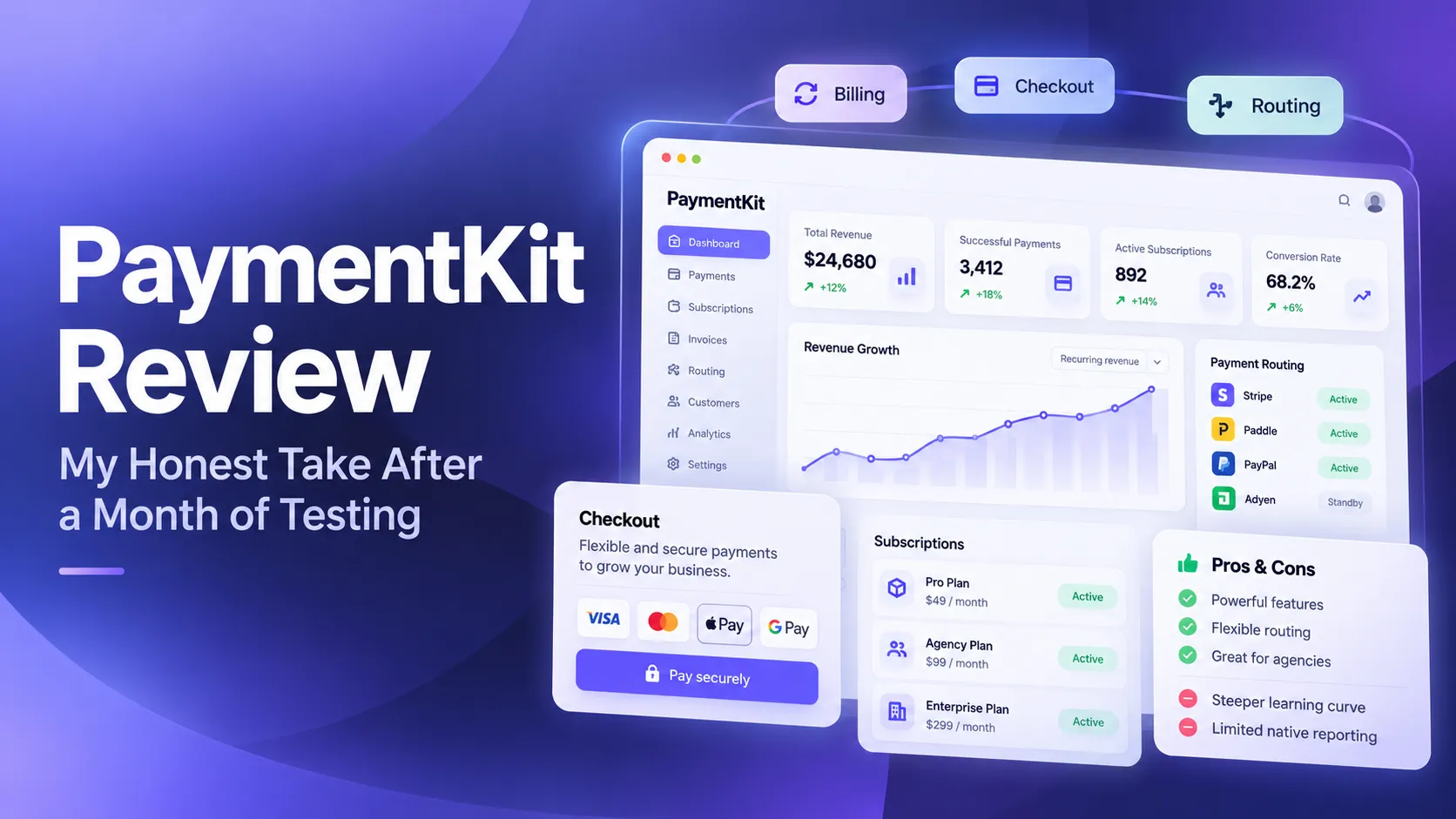



I spent too much of my first afternoon in PaymentKit opening sections I did not need yet. Routing looked important. Webhooks looked important. The API documentation definitely looked important. Then I created a basic checkout, ran a test payment, and realized I had started in the wrong place. For the first few days, the useful part was much simpler: I needed to see how a customer moves from a product to a payment and what I could actually manage without building anything.
A month later, I still had not explored every corner of PaymentKit. I no longer saw that as a problem. The parts I returned to repeatedly became much more interesting than the ones I opened once because they sounded advanced. My opinion formed around that difference.
The First Week Was Mostly Checkout and Test Payments
I started in the sandbox because I did not want real transactions involved while I was figuring things out. I created products, worked through checkout, and deliberately went back through the same flow several times. The repetition was useful. Small questions appeared once I stopped treating a successful payment as the end of the test. Where does the customer land afterward? What information stays attached to the payment? What would I want to check if the transaction failed?
I also spent time with payment links. Payment kit lets me create a link that opens a hosted checkout without building a separate checkout integration. That was one of the simplest features to grasp since it had practically no abstract concepts. I was able to establish the link and then open it to see what customers would see. The experience gave me a basis of understanding before thinking through embedded checking and other complex features.
What Stood Out and What Needed More Time
What Stood Out Early
Hosted checkout stayed useful throughout the month. I liked having something I could test without first deciding how a custom integration should work. The sandbox mattered for the same reason. I could try a payment flow, change something, and repeat it without turning every experiment into a development task. PaymentKit supports hosted checkout, embedded checkout, no code billing through the dashboard, and API based integration, so I did not feel pushed toward the most technical option immediately.
Billing became more fascinating after the first week. At first, I was just checking if a payment had gone through. However, once I started looking into subscriptions, the questions became much deeper. I had to think about renewals, invoices, payment methods, and cancellations, which were much more interesting than just a simple payment completing. This is when I also started to understand the importance of the customer portal because this is where the customer can manage their payments and subscriptions.
What Took Longer to Evaluate
Routing was the clearest example of something I understood before I could properly judge it. PaymentKit can work with an ordered route of multiple processors and move to another processor when the first cannot handle a payment under the supported conditions. That is easy enough to understand on paper. It is much harder to form a useful opinion about it when the test setup does not have the complexity that makes routing important. PaymentKit currently requires at least two connected processors for processor routes, and those routes are configured through the API.
Webhooks fell into a similar category for me. I could see where I would use them, particularly when another system needs to react to a successful or failed payment. I did not spend much of the month experimenting with them because my attention was elsewhere. That was one of the things I would test more seriously in a longer evaluation. PaymentKit supports webhook notifications for payment events and other account activity.
I Stopped Trying to Test Everything
About halfway through the month, I gave up the checklist mentality regarding the interface. From that moment on, my use of the interface changed. Rather than opening another screen, I revisited flows that I was likely to use. I initiated more checkouts, analyzed subscriptions, and focused more on what was actually visible after payment. The less relevant features remained largely ignored.
That turned out to be useful information too. A feature can be technically impressive and still have almost no role in a particular payment setup. Routing is a good example. If I were working with several processors, I would spend much more time there. With a simpler setup, checkout and billing naturally received more attention.
Failed Payments Told Me More Than Successful Ones
Early on, I was satisfied when a test payment completed. Later, that became the least interesting scenario. A successful payment follows the route I expected, so there is not much to investigate. Failure makes me look around.
I began checking what information remained available after unsuccessful attempts and what the next action would be. I also started thinking more carefully about subscription failures rather than only the initial checkout. That made the sandbox considerably more valuable to me than it had seemed on day one. It was no longer a place to prove that checkout worked. It was where I could deliberately look for awkward situations before they involved a real customer. PaymentKit’s sandbox credentials use test payment methods and do not process real payments.
My Opinion After a Month Is More Specific Than It Was After a Week
After the first week, I probably would have described PaymentKit in terms of its feature set. After a month, my view is narrower. I care most about the parts I would actually return to during normal work: checkout, billing, subscriptions, customer payment management, and safe testing. The more advanced integration options matter, but I would not pretend that a month of testing gave me equal experience with all of them.
That is probably the biggest change in my opinion. I started by asking how much PaymentKit could do. I ended up asking which parts solved situations I could clearly describe. That second question was much more useful. A month was enough to find the areas I would keep using and, equally important, the ones I would leave alone until I had a real reason to need them.