Skip to content
  Get the best 3-year deal NOW →
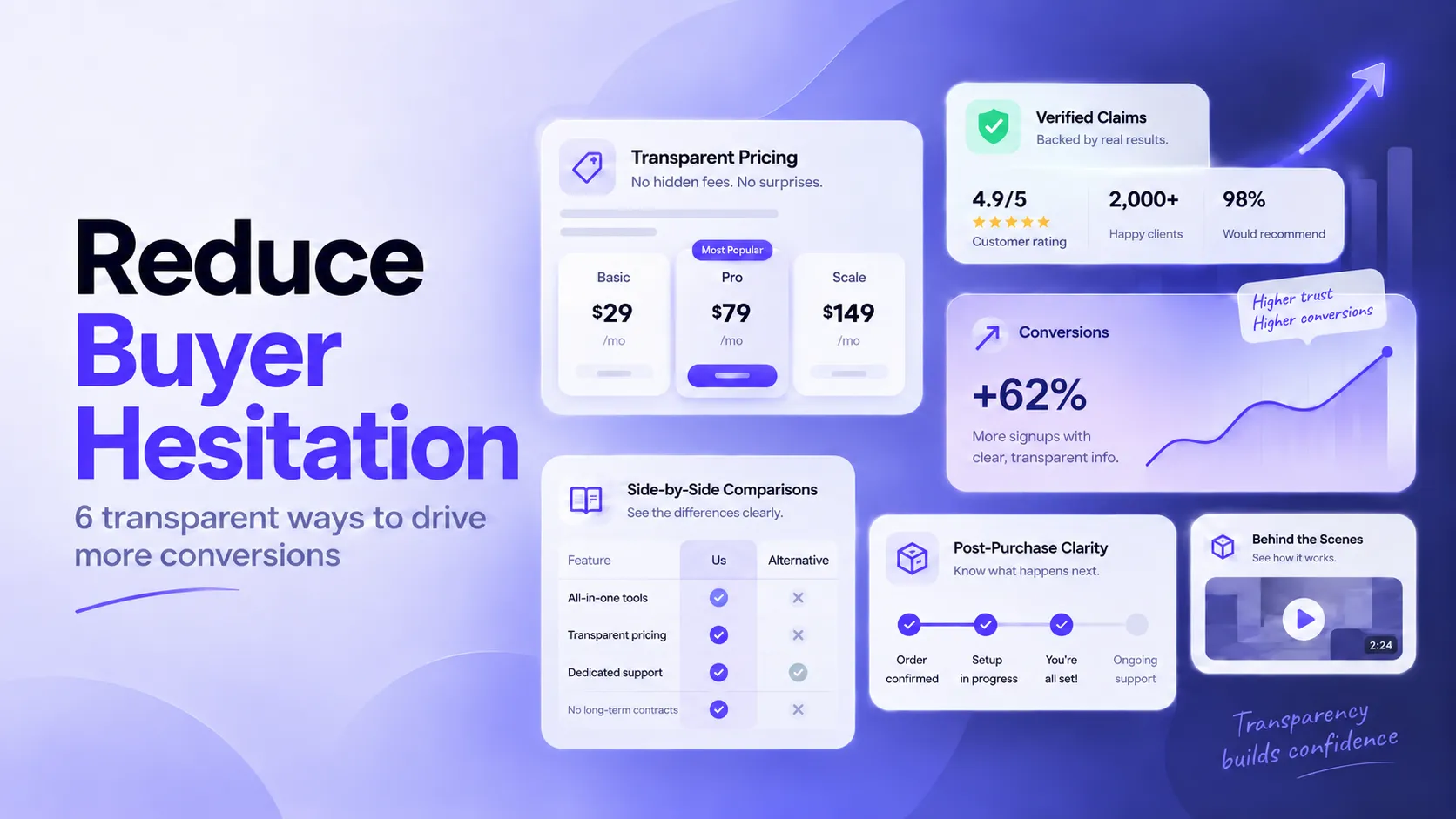



What do consumers expect when deciding what brands to buy? Value for money, product/service quality, and dependable customer care all influence purchase decisions. But if you look at the biggest expectation most shoppers have as they move through the sales funnel, you’ll find that it’s predictability. Ultimately, knowing what to expect from a purchase remains one of the most straightforward ways to reduce buyer hesitation and drive more conversions.
But how can you show your target audience they can count on your business to fulfill its promises and prioritize customer needs? Honesty always works, and most consumers appreciate transparent businesses. In fact, recent consumer survey data shows that 96% of consumers value brand transparency.
To profit from the transparency advantage, you’ll want to understand which areas of the customer journey need more open, honest communication. These six strategies can help you position your brand as transparent and dependable to elevate buyer confidence and boost sales.
Be Upfront About the Price and What It Includes
Cost is a major purchase-influencing factor, especially in 2026.
Over the past few months, people’s spending has significantly gone down. Moreover, value-seeking has become more widespread. And the reason is simple. Consumers are facing mounting global financial pressure.
From this alone, it’s safe to assume that shoppers aren’t ready for price-related surprises.
In fact, if you look at the most common reasons shoppers abandon their carts, you’ll find that 40% of people abandon purchases because of high extra costs (which brands usually don’t disclose on product and collection pages). To prevent this behavior and drive higher conversion rates, be upfront about the price of your offer along with everything it includes.
Don’t just tell potential customers what they will pay for a product or service. Instead, be transparent about what the price does or doesn’t include, list any recurring charges, and mention factors that could affect the final cost.
Sometimes, small surcharges add up quickly, so brands think that excluding them from their pricing strategy makes the most sense for marketing. But the outcome is quite the opposite. Consumers set expectations based on an advertised price, then get a negative surprise when they realize they need to pay significantly more to receive a product or service. Unsurprisingly, this is a major conversion killer.
For a positive example of how to reduce buyer hesitation and prevent brand disappointment, check out Inspecable. This brand’s pricing policy may not align with traditional practices. But it’s transparent and predictable, which is exactly what customers want from safety and compliance inspection SaaS solutions. By breaking down its pricing policy into easy-to-understand elements (and being open about one-off fees), Inspecable makes it easy for leads to calculate their spend. Plus, the interactive calculator estimates the exact cost customers will pay based on customizable criteria, making the pricing policy even more user-friendly.

Source: inspecable.com
Disclose Product Drawbacks Alongside the Benefits
Poor expectation management is one of the biggest (and most common) marketing traps brands fall into.
The goal of promoting products and services is simple. It is to convince consumers that a solution effectively resolves a specific pain point. But in trying to engage as many leads as possible (and encourage them to convert), many businesses fail to mention drawbacks and limitations that can limit their offer’s suitability. And that’s when customer disappointment happens.
Research shows that consumers who have a negative experience with a brand don’t stick around. 24% will leave a brand after a single negative customer experience. 46% will do so after two unsatisfactory CX interactions.
One of the easiest ways to remove this conversion obstacle from your sales funnel and help leads feel confident enough to make a positive buying decision is to be transparent about product drawbacks.
Instead of focusing solely on benefits, list any potential limitations, trade-offs, and unsuitable use-cases. Sure, it may turn away a small portion of your target audience. But it will also give customers a more complete picture of what to expect (or not to) from your solutions, helping them judge whether those compromises matter for their unique needs. If not, they’ll trust your brand more for being honest. If yes, they’ll still retain a positive perception of your organization, preventing them from converting into customers, becoming disappointed, then potentially leaving a negative review, which could significantly harm your company’s reputation.
Sleep Junkie’s Best Mattresses guide is an excellent example of how a brand can disclose product limitations while still strongly highlighting pros and benefits. By listing each product’s drawbacks in its buying guide, Sleep Junkie helps web visitors make informed, confident buying decisions without pushing them to convert when that doesn’t align with their needs. In doing so, it maintains its reputation as a trustworthy, dependable advisor on all things mattress-related, ensuring shoppers continue turning to it for advice and using its buying guides to make high-stakes purchase decisions that genuinely impact their day-to-day quality of life.

Source: sleepjunkie.com
Back Up Claims With Evidence Buyers Can Verify
Composing engaging, conversion-inspiring value propositions is crucial for attracting leads and drawing them into your sales funnel. But claims you can’t prove or that sound too good to be true aren’t necessarily the way to go — especially when you’re trying to reduce buyer hesitation and drive more conversions.
But why does transparency matter in your marketing practices? Well, consumers already don’t trust ads. For instance, recent data shows that 48% of people don’t think companies are following regulations when promoting their products and services.
To avoid making the wrong buying decisions, most shoppers try to verify brand claims. Some browse customer reviews. Others seek out third-party proof. And some take deep dives into technical product specifications and spend hours (if not days, weeks, months) researching their purchases.
One way to be transparent about your claims, and prove to shoppers they can trust your business to deliver on its promises, is to back up all claims with verifiable evidence. Explaining your testing methodology, showcasing third-party certifications, linking to product research and test results, or featuring documented performance data throughout your online presence is an easy way to establish brand credibility and reduce buyer hesitation.
For example, standing by its idea that supplements need to be backed by clinical research, Ritual gives shoppers easy access to the clinical studies it has conducted on the products it sells. In doing so, the brand doesn’t just claim that it sells effective, science-backed solutions. Instead, it provides shoppers with a way to check for themselves, demonstrating its commitment to transparency, earning customer trust, and positioning itself as a dependable brand in an otherwise low-trust industry.

Source: ritual.com
Set Clear Expectations About What Happens After Purchase
What’s the key to boosting business success through conversion optimization? Is it getting leads to invest in your products/services? Or making them into loyal customers?
Research shows CX-oriented brands are 2.5 times more likely to grow their market share. So, investing in customer satisfaction matters. One of the best ways to do it is through transparent expectation management that directly addresses the post-purchase stage of the sales cycle.
Showing your customers what to expect once they commit is a great way to reduce buyer hesitation. Outline relevant post-purchase steps. Explain production and delivery timelines. Educate prospects about product maintenance and any responsibilities they may have. Finally, provide guidelines for what to do if anything goes awry. These tactics are just a few ways to set clear expectations about the loyalty stage of the buyer’s journey.
For example, if you check out Kärcher’s guide to maximizing pressure washer lifespan, you’ll find that the brand tells customers everything they need to know about proper usage and maintenance. Yes, the brand sells high-quality solutions suitable for both home and professional use. But proper handling, cleaning, and storage still affect product lifespan, which directly relates to customer experience. By transparently outlining customer responsibilities, Kärcher sets audience expectations regarding what happens post-purchase.

Source: kaercher.com
Help Buyers Compare Their Options Side by Side
Most consumers consider, evaluate, and compare multiple solutions when navigating the buyer’s journey. Yes, their two main purchase-influencing factors are price and quality. But they also pay attention to whether a product or service fits their unique needs.
To reduce uncertainty and make a buying decision they’re most likely to be satisfied with, most buyers compare multiple options (whether from the same brand or multiple competitors).
With this in mind, one of the best ways to use transparency to your advantage is to make the comparison process as user-friendly as possible. Side-by-side comparisons are the logical tactic to help prospects evaluate the differences between realistic alternatives. Of course, some comparison tables put one solution against another pro forma. Others genuinely help remove buyers’ doubts and drive confident buying decisions.
To ensure the latter is true of your comparison resources, prioritize comparing concrete product/service features and capabilities. Cover factors that truly affect customer satisfaction. And be very transparent about what makes one solution superior to another.
For example, in comparing its tracking card with conventional trackers, Spotminders makes it exceptionally easy for potential customers to identify and evaluate the differences between its solution and alternative products. Because the table is designed in a way that makes product comparison super easy for anyone, it’s a valuable pre-purchase resource that can instill buyers with confidence about choosing Spotminders’ product, seeing that it clearly delivers several unique benefits compared to similar alternatives.

Source: spotminders.com
Give Buyers a Look Behind the Scenes
Lastly, as you explore opportunities to remove buyer hesitation with transparent messaging, remember that consumers don’t necessarily trust big organizations (or algorithms, for that matter). Instead, most people trust authentic, human expertise, which you can show by highlighting your brand’s inner workings.
So, instead of leaving the unseen parts of your business invisible, help your potential customers better understand what happens behind the scenes.
What does it take for a product to go from components to a finished solution? How does your team ensure customers receive top-notch service?
By being transparent with behind-the-scenes content, you can show your experts doing the work that goes into delivering a great CX. You can demonstrate professional expertise. Or you can reassure leads about your manufacturing and quality-control processes. It’s more than a method to boost buyer confidence and drive more conversions. It can also protect you from consumer skepticism, especially regarding sustainable practices.
For instance, if you check out the Worth & Worth hat shop’s About page, you’ll find that it’s filled with candid photographs from the brand’s workshop along with personal stories that describe the work, expertise, and creative dedication that go into making each design. By offering customers this type of behind-the-scenes glimpse into the fascinating world of hatmaking, Worth & Worth effectively elevates aspirational appeal and purchase intent.

Source: hatshop.com
Final Thoughts
Transparency may commonly be overlooked in marketing. But it’s a strategy that can give your brand a genuine advantage, especially when the goal is to earn your customers’ trust, remove their conversion obstacles, or guide them closer to a conversion.
Showing your target audience they can rely on your business is, of course, the first step toward converting more customers. But the work doesn’t stop there. Nurturing leads takes a lot of work, which is where a high-quality CRM solution like Agency Handy comes into play.