Skip to content
  Get the best 3-year deal NOW →



You built a clean service catalog with clear packages and pricing. You see prospects landing on your page. But you also notice that they’re not converting.
The reason is simple. Prospects can’t see what you have actually delivered before. That’s where you need a portfolio linked to your specific service. It lets your prospects see your real work linked to real services before making any commitment.
So, let’s see why a portfolio is important, what to include, and best practices.
What is a Portfolio?
A portfolio in a productized service is a set of your service examples that you’ve successfully provided to previous clients. You link work samples directly to your specific service. This way, a client browsing for your services can see your real projects and make decisions.
While a generic portfolio works as a gallery, a productized portfolio sits next to your offer. That said, portfolio functionality varies from software to software. Some tools let you add a project name and image. Others support files, descriptions, and direct service linking.
The depth of the feature determines how well your past work actually sells your next project.
Why Does a Productized Service Need a Portfolio?
Before a prospect turns into your client, they want evidence of your work. Without it, even your best productized service won’t sell.
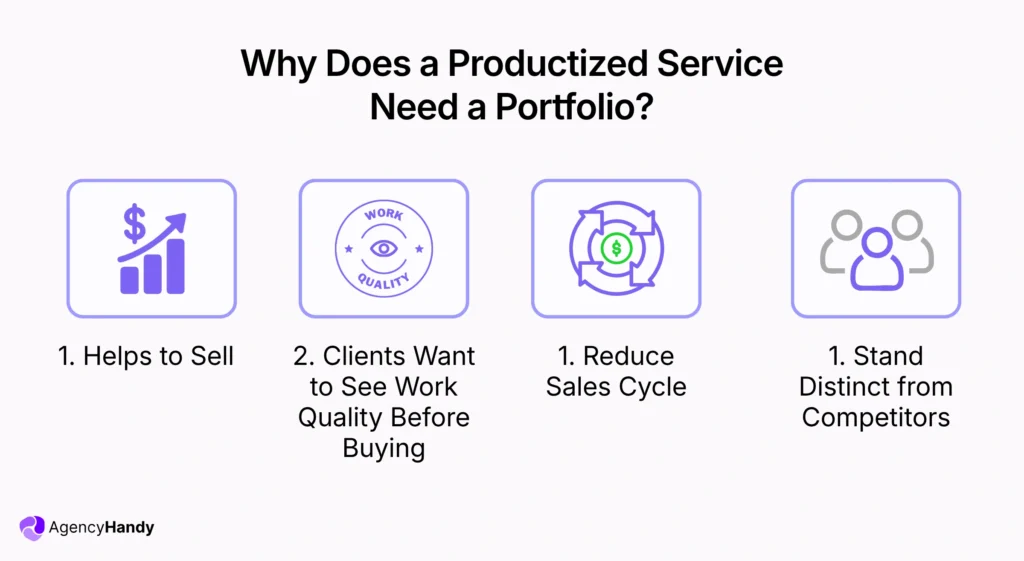
1. Helps to Sell
A productized model is basically a self-serve purchase. Here, your portfolio does the selling for you.
See, the moment a prospect lands on your service catalog, they’re at the edge of a purchasing decision. A service catalog is the front door of your productized business. To understand how it fits into the full software stack, read Productized Service Software: Definition, Benefits, Top Software & More.
Now, if a prospect can see your portfolio linked to their required service, they can make the decision confidently.
2. Clients Want to See Work Quality Before Buying
If you put yourself in a client’s shoes, you won’t buy on description alone.
You’ll want to see the actual work examples to decide. The same goes with your future client. Here, a portfolio gives them that visibility without any back-and-forth conversation.
For example, you find an agency that offers three web design packages. And you need to decide between the Standard and Premium tiers. Then, you find a portfolio with real project samples tagged to each package.
In under two minutes, you can see the difference in layout complexity, custom functionality, and visual finish. That comparison alone removes your hesitation.
3. Reduce Sales Cycle
Most of the time, a productized service takes a long sales cycle. It’s not always the price. In fact, when a client can’t see service examples, they stop.
Then, they —
- Ask for work samples
- Want to see social proof
- Request an intro call to see past projects
These steps extend the sales cycle. But a service-linked portfolio crops the cycle short.
And that makes sense. When you have evidence linked to your offer, it hits the trust signal at the beginning.
4. Stand Distinct from Competitors
Browse ten productized services, and they all start to look the same. Most of them have the —
- Service catalog
- Similar pricing structures
- Almost the same package names
So, by default, clients tend to go for the cheapest options. Because there are no differentiators!
Exactly, that’s where a portfolio changes the game. It shows the prospect of your work quality, style, and results. Most importantly, they can’t be copied. So, you stay distinct from others.
What to Include in Your Productized Service Portfolio
You must include structured information in your productized service portfolio. The work samples you attach to your portfolio should reflect the exact scope of each package you offer. If you need guidance on structuring those packages, feel free to check how to package your services.
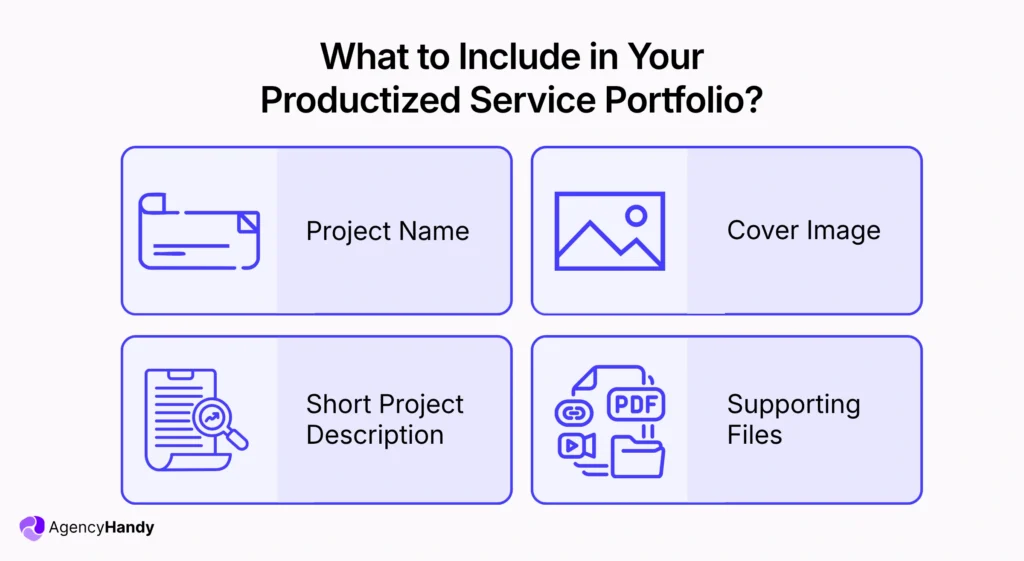
Let’s see the important things you need to include —
1. Project Name
Add a specific and clear project name to your portfolio. Because this is the first thing your prospect reads. Besides, a clear name sets the context and lets the prospect understand —
- What type of work did you do
- What type of business do you serve
- What service package did you offer
- Whether your experience matches their need
This is where your prospects start to connect themselves to your work. Thus, they can decide easily if they need your service.
2. Cover Image
Add a cover image to offer a visual impression. It gives your prospects an idea before they even read a single word.
That said, avoid using blurry screenshots. Instead, always use a high-quality cover image to reflect your professionalism.
You could be offering non-visual services, like content writing, SEO, or consultation. In that case, you can use a before-and-after visual. Ultimately, the goal is to answer your prospects: how well can you do the work? That’s it!
3. Short Project Description
Add a short yet meaningful project description. It must explain three things clearly to your prospects —
- What you did for your client?
- What did you deliver?
- What was the impact of your work?
While writing a description, aim for a maximum of 3 to 5 sentences.
Also, try to share results wherever possible. Because if a prospect reads something, like “Increased organic traffic 3X”, it sounds more convincing.
4. Supporting Files
A cover image and a description tell a prospect what you did. Meanwhile, your supporting files show them how you did the work.
See, if prospects are weighing a premium service, they want something solid to review before they purchase. Now, it could be, for example —
- SEO audit report
- UI prototype
- Brand style guide
- Before after footage
These works show your prospect, your way of thinking. It gives them the confidence they need to buy your service.
Best Practices for a Productized Service Portfolio That Helps to Convert
Your portfolio should consistently convert prospects into clients. In that case, you should follow the given best practices —
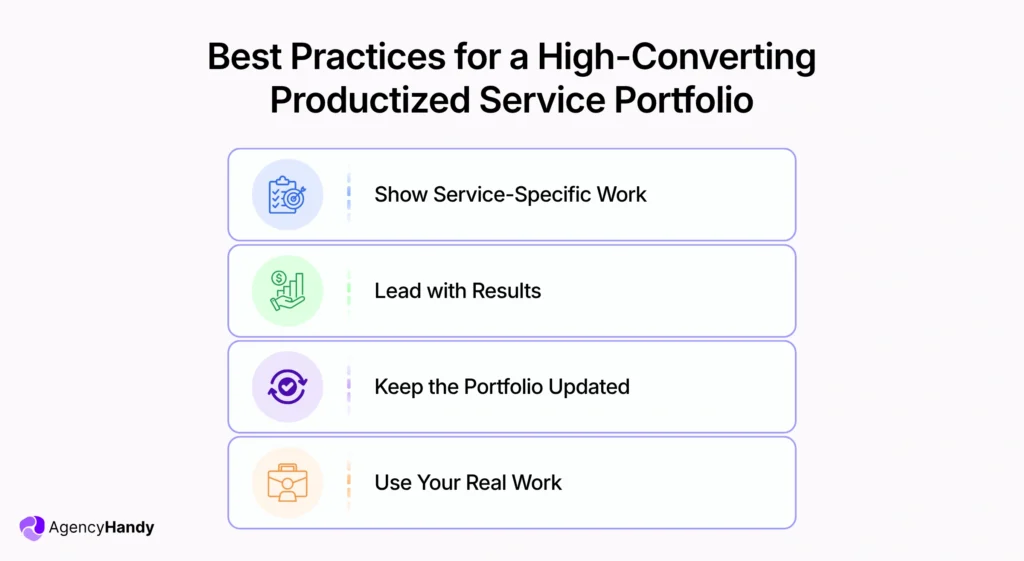
Show Service-Specific Work
If prospects are looking for your social media service, they don’t want to see your logo projects.
Don’t mix unrelated work. Instead, you should —
- Link to past work related to your specific service
- Show examples that directly reflect your service that the prospect is considering
- Remove older projects that show an outdated quality of your work
Remember, your absolute goal is to be relevant.
Lead with Results
To drive conversion, your prospect must see the results you can deliver. Though description and visual matters, your previous outcome impacts the most on a prospect’s mind.
That said, the results shouldn’t always be numbers. It can be —
- A before-and-after comparison that shows visible improvement
- A client goal you met within a specific timeframe
- A measurable change in performance, quality, or output
Then again, if you have numbers, you must use them. For example —
- “Increased organic traffic by 60% in 90 days.”
- “Delivered a full brand identity in 5 days.”
- “Completed full custom web development in 14 days.”
When you share such results, it makes your portfolio more credible.
Keep the Portfolio Updated
Are you in the same condition right now as you were 3 years ago? Absolutely not!
Likewise, a prospect doesn’t want to see years-old work of yours. In fact, they want to know what you can produce now. They want to see if you’re still —
- Active
- Improving
- Worth hiring
You can answer these queries easily by keeping your portfolio updated all the time.
Use Your Real Work
Always use your real work instead of mock-ups. Because a prospect can easily differentiate between a kind of demo and real deliverables.
That said, it’s possible that you’ve started new productized services. So, you might not have genuine client work. In this case, you can show your practice projects clearly.
How to Build and Manage Your Portfolio with Agency Handy
Agency Handy integrates a portfolio feature to let you showcase your real work while offering a productized service.
It starts with the service catalog, where you can describe your services, set pricing, and offer multiple packages. Plus, you can make the catalog public, embed it on your website, or share via a direct link.
Beyond that, Agency Handy lets you apply your own logo and color palette to the client portal. So when a prospect browses your portfolio, they see your brand.
Now, within that catalog, the portfolio feature lets you attach real past work directly to specific services. It lets you add a —
- Project name
- Description
- Cover image
- Supporting files up to 1 GB
Thus, your prospects can see relevant proof exactly where they need it. Once the portfolio builds trust, Agency Handy offers coupons and add-ons.
Final Words
It’s not that hard to build a portfolio for your productized service. You just need the right name, description, visual, and supporting files. When you can combine them, it can play a great role in converting a prospect into a client.
Agency Handy lets you build exactly that. It comes with a linked service catalog where you can add a structured portfolio of your example services. You can add the name, description, visuals, and more to this portfolio. Plus, it gives you coupons to close hesitant buyers and add-ons to increase order value.
FAQs
What is the difference between a portfolio and a case study for a productized agency?
A portfolio entry is a concise snapshot of your real past work. You add the project name, description, visuals, and a short outcome to your portfolio. Meanwhile, a case study explains the full project. Here, you talk about the problems, processes, and results of your work.
What if my agency is new and doesn’t have client work to show yet?
If your agency is new and doesn’t have client work to show, offer one or two projects at a lower rate. It’ll help you to build your first portfolio entries. Otherwise, you can create a few practice projects, but with clear labels.
Should my portfolio be public or only visible to clients?
If you’re offering a productized service, you should make your portfolio public. It eases the self-serve buying process of your prospects. Moreover, it lets your potential clients scan your work and builds the trust they need before purchasing your service.
Does a portfolio work alongside a proposal?
Yes. A portfolio builds trust before a prospect commits. Meanwhile, a proposal locks in the scope, deliverables, and timeline after they are done. The two work in sequence. While a portfolio converts the interest, a proposal converts the intent.