Skip to content
  Get the best 3-year deal NOW →



Your competitor’s pricing reflects their costs, team size, and margins. Not yours. So, if you match their structure without knowing those numbers, you’ll end up underpricing your work pretty fast.
Well, service packaging starts with what you can deliver repeatedly at a profit. You define the scope, set a fixed price, and document the process of your productized service.
So, let’s see how you need to design your service packages that attract clients and maintain a good revenue for the business.
How to Match Your Service Packaging Tiers to the Right Customer Type
Each service package has a role to play in your revenue strategy. The entry tier will bring in new customers. The middle tier will generate most of your revenue. Meanwhile, the Premium tier will handle high-value clients who need everything.
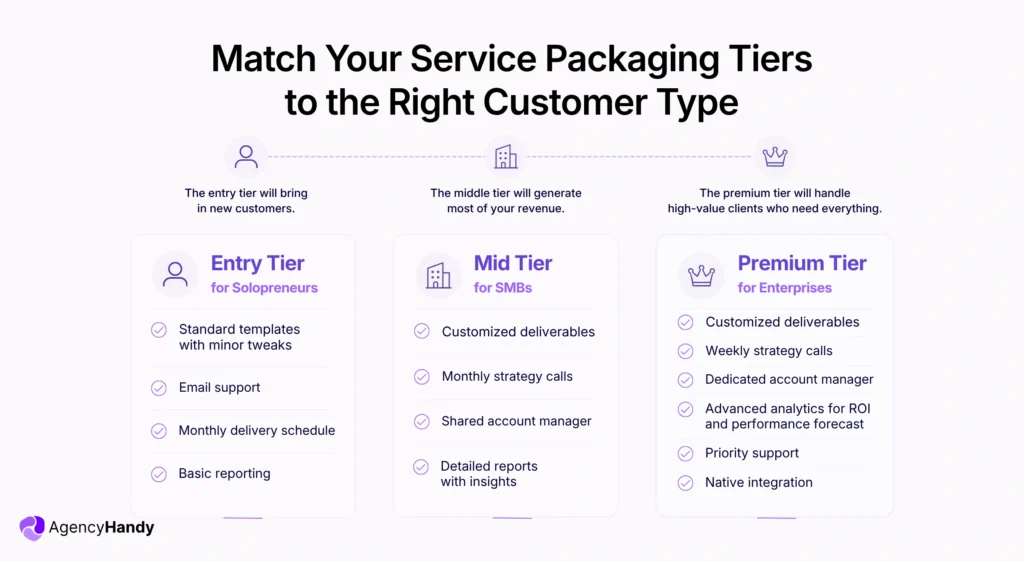
Entry Tier for Solopreneurs
Most freelancers and solopreneurs are okay with entry-level plans. They have a tight budget and need a quick turnaround. But this has to include standard features with minor customization for service packages.
So, here’s what you’ll include —
- Standard templates with minor tweaks
- Email support
- Monthly delivery schedule
- Basic reporting
Mid Tier SMBs
SMBs mostly need core services. But they want to have a room to scale up as they grow. Standard features with custom would work for this tier. For these service packages, you should include —
- Customized deliverables
- Monthly strategy calls
- Shared account manager
- Detailed reports with insights
This tier is your revenue engine. In fact, most mid-tier clients stay long-term. Hence, it’s the right place to introduce a recurring model. Subscription-based pricing covers how to structure that without overcomplicating the offer.
Premium Tier
Enterprises and large businesses go for the highest tier. They need everything customized for strategic planning. So, include the following in this tier —
- Fully customized deliverables
- Weekly strategy calls
- Dedicated account manager
- Advanced analytics for ROI and performance forecast
- Priority support
- Native integration
What Goes in Each Service Package Tier?
Visitors should clearly differentiate between tiers. Other than just staffing more features, focus on 2-3 key differentiating features for tiers.
Two types of features matter here –
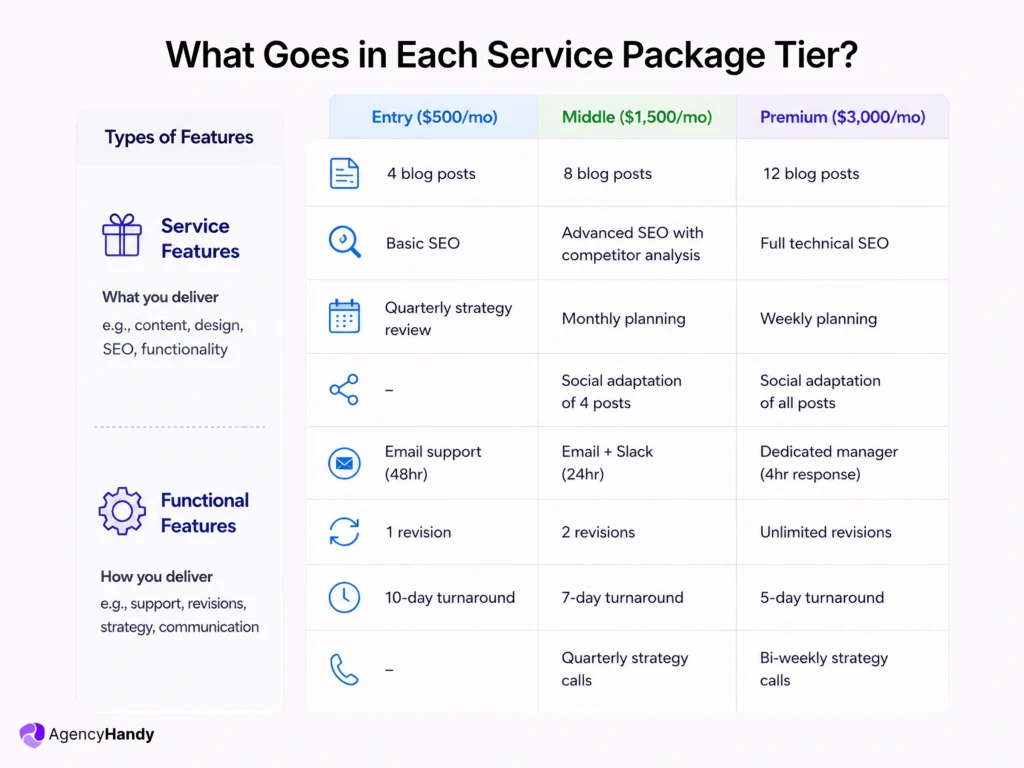
1. Service features
These are what you promise to deliver —
- Content agency: Keyword research, article writing, SEO optimization, distribution.
- Design agency: Brand identity, web design, marketing materials, design systems.
- SaaS product: Core functionality, integrations, automation, reporting, API access.
2. Functional features
These are how you deliver —
- Support response times (48hr vs 24hr vs 4hr)
- Account management (shared team vs dedicated manager)
- Communication channels (email only vs Slack vs phone access)
- Review cycles (1 revision vs 2 vs unlimited)
- Strategic input (quarterly reviews vs monthly planning vs weekly calls)
Service features will show what clients are getting. And the functional features are how smoothly you will be providing services to clients.
If you’re building these packages as part of a productized service operation, the right productized service software can cover the full system.
Here are a few content agency examples for better understanding —
| Entry ($500/mo) | Middle ($1,500/mo) | Premium ($3,000/mo) |
| 4 blog posts | 8 blog posts | 12 blog posts |
| Basic SEO | Advanced SEO with competitor analysis | Full technical SEO |
| Quarterly strategy review | Monthly planning | Weekly planning |
| – | Social adaptation of 4 posts | Social adaptation of all posts |
| – | – | Newsletter support |
| Email support (48hr) | Email + Slack (24hr) | Dedicated manager (4hr response) |
| 1 revision | 2 revisions | Unlimited revisions |
| 10-day turnaround | 7-day turnaround | 5-day turnaround |
| – | Quarterly strategy calls | Bi-weekly strategy calls |
When to Use Add-Ons and Coupons Instead of Expanding Your Package
When packages start to stretch, add-ons and coupons give you control. Let’s see when you should use them.
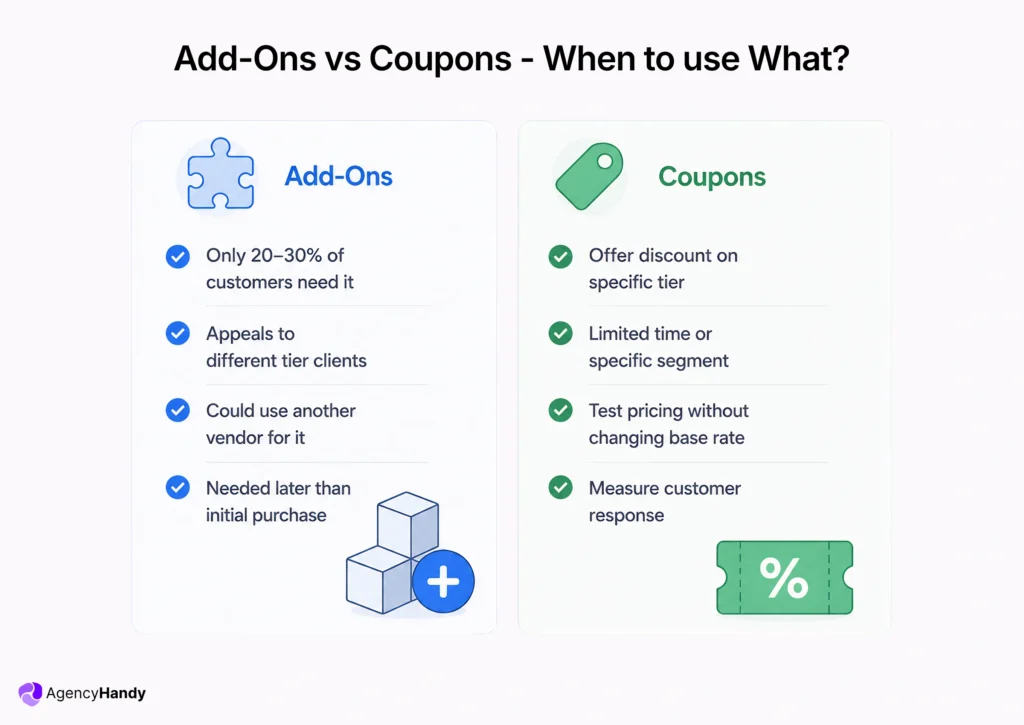
Add-Ons
Let’s say you provide content packages that don’t include video scripts. But you offer them at $300/script as an add-on. Most customers shouldn’t need more than 1-2 add-ons at purchase.
You should offer add-ons when:
- Only 20-30% of customers need it
- It appeals to different tier clients
- Customers could use another vendor for it
- It’s needed later than the initial purchase
Coupons
Coupons give you a pricing lever without touching your base package rates. You offer a fixed or percentage discount on a specific tier. It could be for a limited time or to a specific client segment so that you can measure the response.
And it’s useful when you’re not sure if a new tier is priced too high. Regardless, the package price stays intact.
How to Use Free Trials to Reduce Friction in Your Service Packaging
Customers would want to test your services before they commit. So, reduce as much friction as you can to make people sign up for free trials. Here are various free trial options you can offer clients –
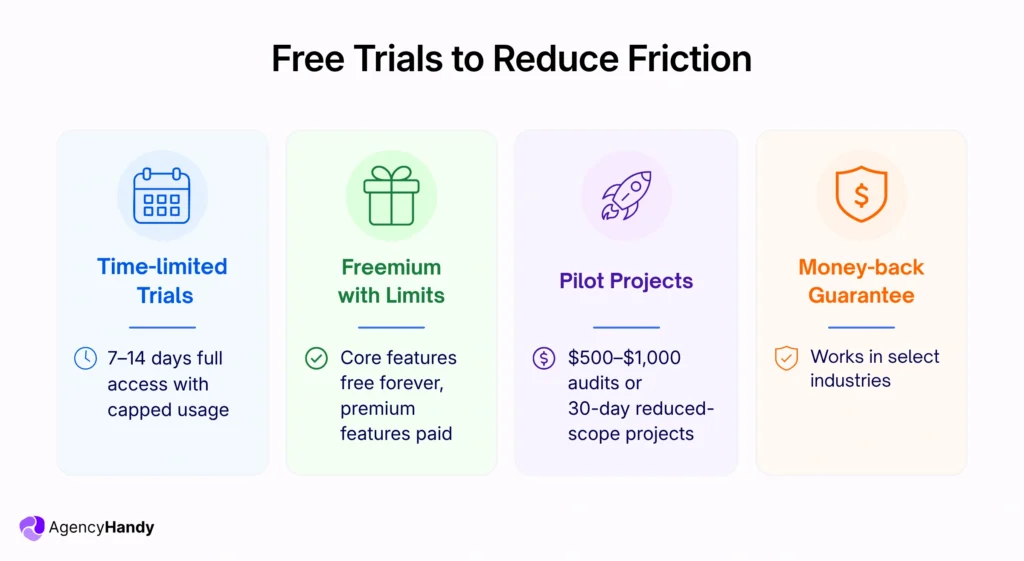
- Time-limited trials: 7-14 days with full access. But with capped usage. No credit card required.
- Freemium with limits: Core features are free forever. They have to pay to get premium features.
- Pilot projects: If you can’t do trials, then offer $500-$1,000 audits or 30-day reduced-scope projects. Money-back guarantees work in some industries.
Your initial goal is to let users experience the value of your service. Once they hit a clear ceiling, they’ll eventually commit to getting more from your service. For a full breakdown of how to offer trials without hurting your margins, check out how to set up free trial services.
How Can You Balance Client Needs and Business Perspective?
Your service packages should serve both your business revenue goal and your clients. Here’s how you can balance between these two:
For the Client
Customers shouldn’t need a 30-minute sales call to figure out what each tier includes. Make sure that the —
- The scope is clear before they sign. There should not be any ambiguity about what’s included.
- Pricing is fixed. Clients know exactly what they pay each month.
- Tier differences are obvious. Each step up solves a bigger or different problem.
For Your Business
Consider the following things for your business revenue:
- Every client in the same tier follows the same delivery process. You shouldn’t be rebuilding the workflow per order.
- Entry tier pricing covers your costs with a margin remaining. Remember, a $500 package that costs $450 to deliver isn’t sustainable.
- Mid and premium tiers generate profit that funds team hires, tools, and growth.
Remember, if you’re packaging for a productized service, repeatability is the core. If the process changes per client, the package isn’t truly productized.
What to Avoid When Packaging Services
Startups commonly make the following mistakes when packaging their services:
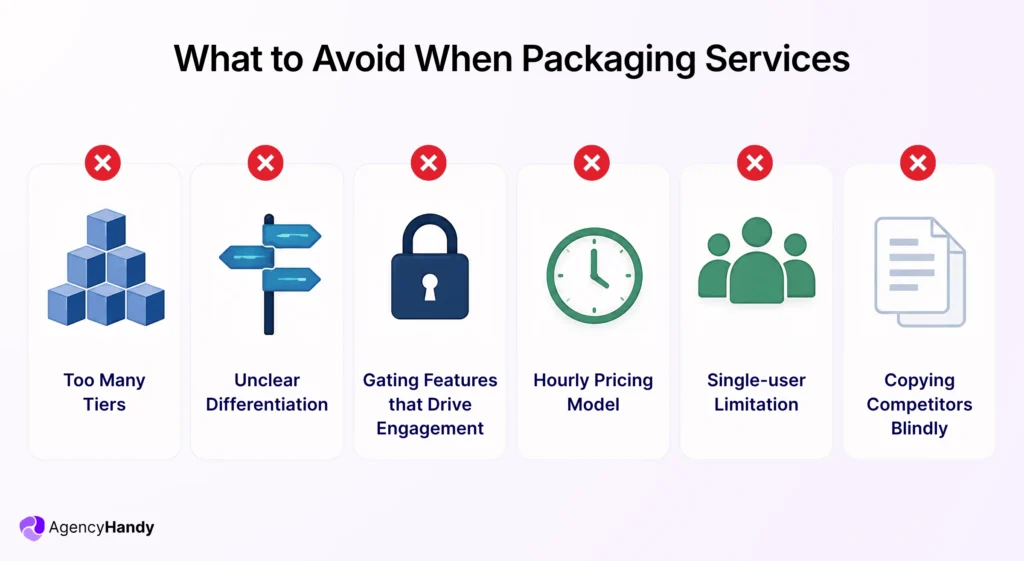
Too Many Tiers
Five or six pricing tiers overwhelm buyers. They have to then spend more time comparing options. Besides, it creates unnecessary friction. Hence, you should stick to 3-4 tiers maximum.
Unclear Differentiation Between Packages
If customers can’t tell why your middle-tier costs $500 more than the entry-level plan, they’ll pick the entry-level plan. So, there should be value gaps like 2-3 features that the lower tier lacks.
Gating Features that Drive Engagement
Some features increase user engagement. You shouldn’t limit these. It includes Integration, collaboration, mobile apps, etc.
When clients can’t integrate with their preferred platform or can’t collaborate with their teams, they churn faster.
Hourly Pricing Model
When you charge by the hour, the scope becomes open-ended. Clients start questioning the time spent instead of the value received. That creates negotiation on every invoice.
So, you’d better price on outcomes instead. “Drive 50 qualified leads/month” clearly indicates the value you will provide. Again, “8 blog posts per month, delivered in 10 days” is a value-driven package. “10 hours of content writing” is not.
Single-user Limitation
If customers can’t add teammates without upgrading to enterprise, you’ll miss easy upsells. Your service packages should allow multiple users. The entry-level tier can be an exception. You can charge per seat or offer team discounts. But better not restrict team usage to only your highest tier.
Copying Competitors Blindly
Your competitor’s pricing might look good, but you don’t know their costs, margins, or strategy. Blindly matching their structure could price you out of profitability. So, only use competitive pricing as a reference point, not a blueprint.
In this case, a proper service pricing plan can give you a structured framework to do that.
How Agency Handy Handles Your Service Packaging from Setup to First Order
You can design your service easily. But when it comes to setting up a system to handle orders, onboarding, and billing, Agency Handy stands out.
- Multi-service Catalog: You create each tier as a separate service with its own description, scope, and fixed price. Clients browse the catalog, pick their tier, and place an order without a sales call.
- Add-ons and Coupons: Once your base packages are live, you attach add-ons for services that only some clients need. Meanwhile, coupons let you run discounts without changing your core pricing structure.
- Intake Form: Right after a client places an order, Agency Handy triggers an intake form. It lets you collect scope details, goals, and deadlines before work starts.
- Proposal: For clients who need a formal scope review before committing, you can send a proposal directly from the platform. It covers deliverables, timelines, and revision limits. The client signs, and then you start the project.
- Invoicing: Agency Handy generates and sends invoices automatically as soon as someone purchases a service. It also accepts payment via Stripe, Wise, PayPal, bank transfer, and crypto.
Frequently Asked Questions
How long does it take to build a service package?
To build a service package, you’ll need 2-4 weeks. One week for calculating costs and validating with customers. Two weeks for documenting processes and setting up systems. Test with 3-5 clients before full launch.
What if customers only buy my cheapest package?
If customers only buy my cheapest package, your middle tier isn’t differentiated enough, or the entry tier offers too much value. Thus, add 2-3 must-have features to the middle tier that the entry lacks. Also, remove non-essential features from the entry.
Can I change my packaging model after launch?
Yes, you can change your packaging model after launch. Most agencies switch models 2-3 times a year. You can start with Good-Better-Best. And then gather data for 90 days. Then adjust packages based on results and engagement.
How do I know if my add-ons are priced right?
You can track the attach rate. If fewer than 15% buy an add-on, it’s either too expensive or not valuable enough. Again, if more than 40% buy it, you should bundle it into base packages instead.
How many revisions should I include per tier?
The entry tier gets 1 revision, and the middle tier gets 2. In the meantime, the premium gets unlimited or 3-5, depending on deliverable complexity. More revisions than this and you’re absorbing scope creep as a cost.
Final Words
It’s not that you complete service packaging once, and that’s all for the lifetime. You’ll have to use your best guess based on customer conversations and cost calculations. Some tiers will attract more buyers than expected. Others won’t convert at all.
That’s normal. You should revisit your packages half-yearly and adjust based on actual behavior, not assumptions.