Skip to content

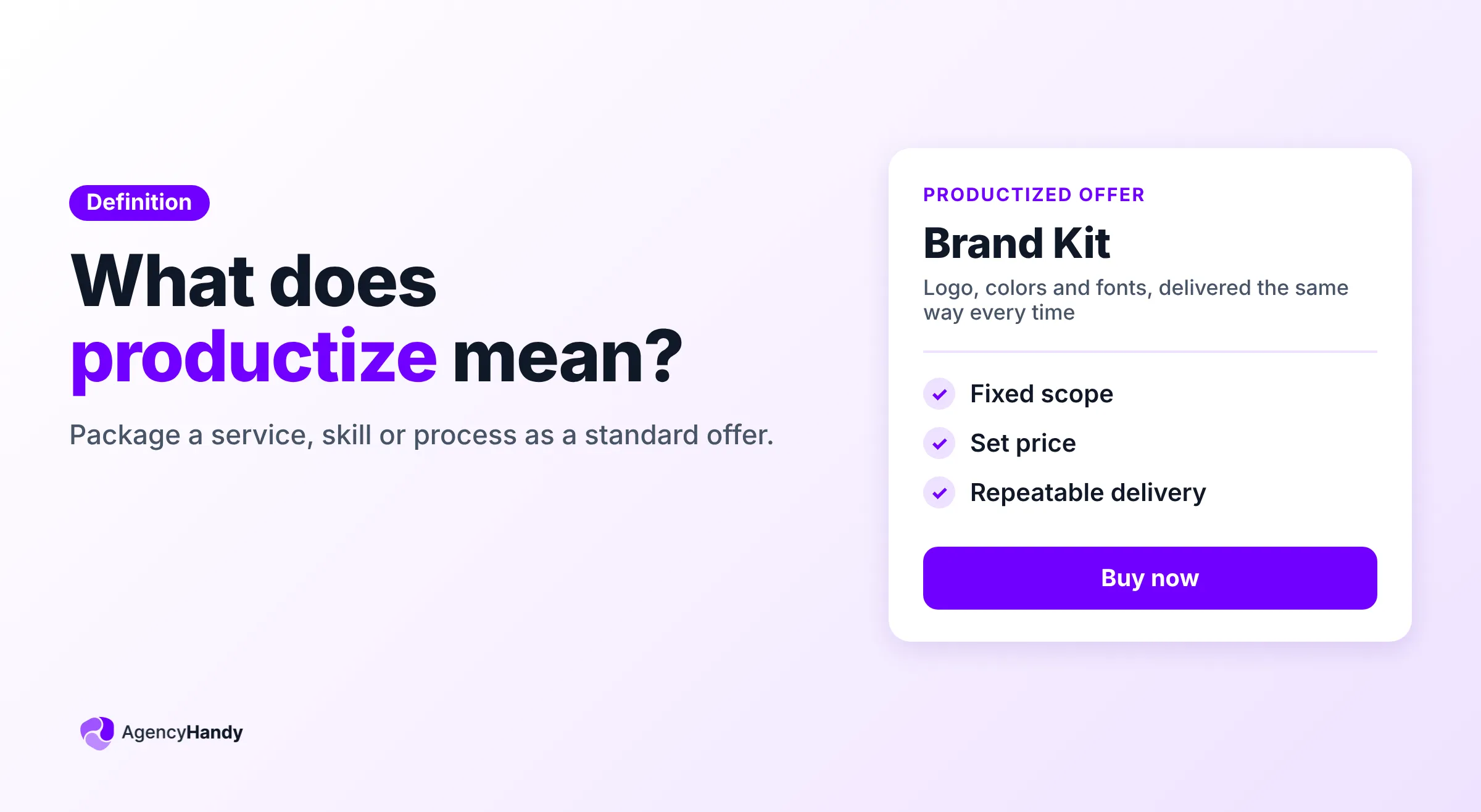



You’ve probably seen “productize” on a pricing page or in a job post and wondered if it’s a real word. It is.
To productize is to package a service, skill, or process as a standard offer. It gets a fixed scope, a set price, and the same delivery every time.
The word has a UK spelling, productise, and a lookalike, productionize, that means something else entirely.
You’ll get the meaning, the spellings, the difference between the two lookalikes, and the steps to productize your own work.
Key points
- To productize is to package a service, skill, or process as a standard offer with a fixed scope, a set price, and repeatable delivery.
- Productize is the US spelling and productise is the UK spelling. Productionize is a different word: it means making a prototype or model ready to run in production.
- To productize your business, start with your best service, fix its deliverables and price, then add tiers and automate delivery.
What Does Productize Mean?
To productize is to package something you do, such as a service, a skill or a process, as a standard offer. It comes with a fixed scope, a set price, and the same delivery every time. Wiktionary defines the verb as making something into a commercial product.
Instead of creating customized solutions for every customer, you develop standardized packages with clearly defined features, fixed pricing, and predictable outcomes. A client sees what they get and what it costs before they talk to you.
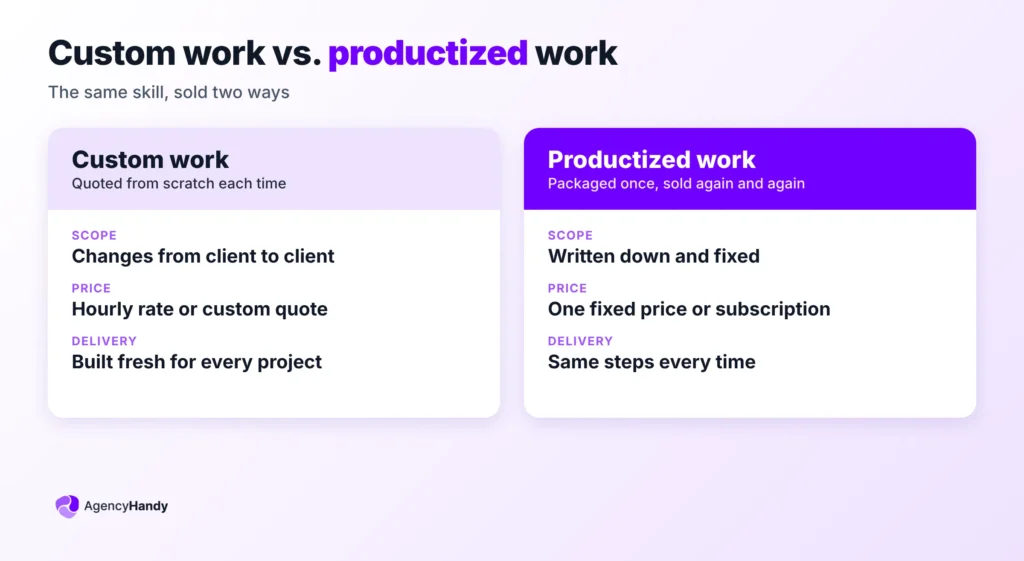
Three things separate a productized offer from custom work:
- Scope: The deliverables are written down and don’t change from client to client.
- Price: One fixed price or subscription replaces the hourly quote.
- Delivery: The same steps run every time, often with templates and automation.
The primary goal of creating a productized service is to maintain efficiency and profitability while minimizing the unpredictability of custom work. It isn’t a cheaper version of your service. It’s the same service with the guesswork removed.
Say a consultant sells strategy calls by the hour. Productized, the same advice becomes a fixed-price audit with a written report and a set delivery date.
Our guide to what a productized service is covers the offer itself in more depth.
Which is Correct, Productize or Productise?
Both are correct. Productize is the US spelling and productise is the UK spelling, according to Cambridge Dictionary. Pick one and use it everywhere on your site.
The same split applies to every word form. This table shows each form and how it reads in a sentence.
| US spelling | UK spelling | Part of speech | Example |
|---|---|---|---|
| productize | productise | Verb | We plan to productize our SEO audit. |
| productizes | productises | Verb (third person) | She productizes every workshop she runs. |
| productized | productised | Verb (past) or adjective | A productized service has a fixed price. |
| productizing | productising | Verb (-ing form) | Productizing starts with one clear offer. |
| productization | productisation | Noun | Productization starts with your best service. |
Word forms are from Wiktionary. UK spellings are from Cambridge Dictionary.
Stress the first syllable when you say it: PRAH-duk-tyze. And don’t confuse any of these with productionize. That’s a different word.
What is the Difference Between Productize and Productionize?
Productize means to package something so customers can buy it. Productionize means to make a prototype, model or piece of code dependable enough to run in production. One is about selling. The other is about running.
| Word | Meaning | Where you see it | Example |
|---|---|---|---|
| Productize | Package a service, skill or idea as a standard offer that can be sold repeatedly | Agencies, consultants, founders and product teams | A design studio sells a logo package at a fixed price |
| Productionize | Make a prototype, model or code ready to run in a live environment | Software, data science and machine learning teams | A data team moves a notebook into a tested pipeline |
The examples are illustrations, not client cases. Productionalize is a variant of productionize with the same sense.
Productionize has a manufacturing sense too. Wikipedia describes productionisation as the process of turning a prototype of a design into a version that is easier to mass-produce. In software, it says the term means making a prototype production or enterprise grade. That covers error handling, stability and performance.
One product can go through both steps. A team productionizes a model so it runs without breaking. The company then productizes it as a paid feature.
What Are Examples of Productization?
Productization works on three things you sell: services, processes and expertise. The examples below are illustrations, not real client cases. Each follows the same pattern: a clear package, a fixed price and a repeatable way to deliver it. For more, see our list of examples of productized services.
Productizing Services
Instead of handling every project as a custom job, you can standardize your offerings into clear, easy-to-understand packages. For example, a design agency might create a “Logo Design Essentials Package” with three logo concepts, one round of revisions and a final design file.
You can also offer tiered packages to meet different client needs. For instance, an “Advanced Branding Package” could include everything from the essentials plus extras like business cards and social media templates.
Productizing Processes
You can package a proven process as a subscription that serves many clients at once.
For example, a marketing consultant could offer a monthly subscription toolkit. It might include step-by-step email marketing templates, ready-to-use social media calendars, and performance-tracking dashboards.
This approach makes your expertise available to more clients without the need for one-on-one consultations. It saves you time while providing clients with the resources they need to succeed.
Productizing Expertise
You can package your skills as a structured offer that reaches more people. For example, a yoga expert could replace one-on-one sessions with an online course like “Yoga for Busy Professionals.” This 12-week program might include guided video lessons, downloadable schedules, and bonus mindfulness exercises.
The course could be sold as a one-time purchase or offered as a subscription that includes live monthly workshops or fresh routines. That lets the yoga expert reach a global audience with a repeatable offer.
Why Should You Try Productizing?
A productized business model changes how you deliver services. Fixed-price packages cut scope creep, speed up closing and make revenue easier to predict. Five benefits stand out, and each one comes from fixing the scope and price before work starts.
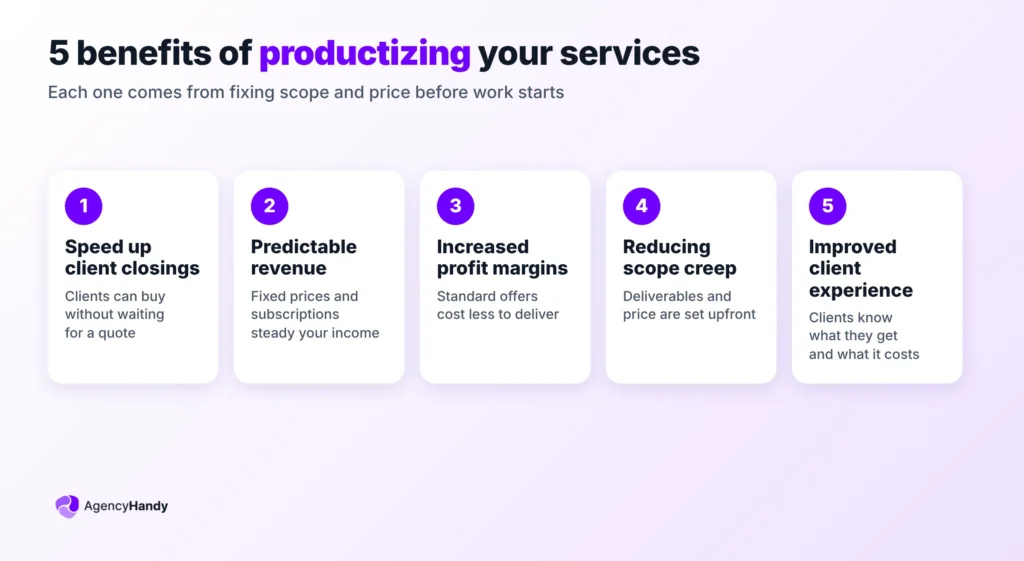
1. Speed Up Client Closings
Clients find it easier to buy services like website design or SEO audits with one click. They avoid the hassle of contacting providers, sharing project details, and waiting for quotes. This makes it faster for you to start the project with less back-and-forth communication.
2. Predictable Revenue
With fixed pricing or subscription models, productized services give you consistent income. This financial predictability makes it easier to manage cash flow and plan for future growth.
3. Increased Profit Margins
Standard offers cut the cost of customizing and delivering each project. That leaves more profit on every sale. Productized service software that handles intake, billing and delivery cuts the cost further.
How much margin you keep depends on your costs, so work it out with your own numbers.
4. Reducing Scope Creep
Productization helps avoid scope creep by clearly defining the service scope, deliverables, and pricing upfront.
With standardized packages, clients know exactly what they are paying for and what is included. This leaves no room for misunderstandings or additional requests outside the agreed terms.
5. Improved Client Experience
Clear deliverables, transparent pricing, and defined processes eliminate ambiguity. Clients know exactly what they’re getting, leading to better satisfaction and trust.
How Do You Productize Your Business?
To productize a business, start with your best service, then fix its scope and price, pick a niche, build tiers and simplify delivery. Six steps cover it. This is the short version. For order forms, billing and workflows, read our full guide on how to productize a service.
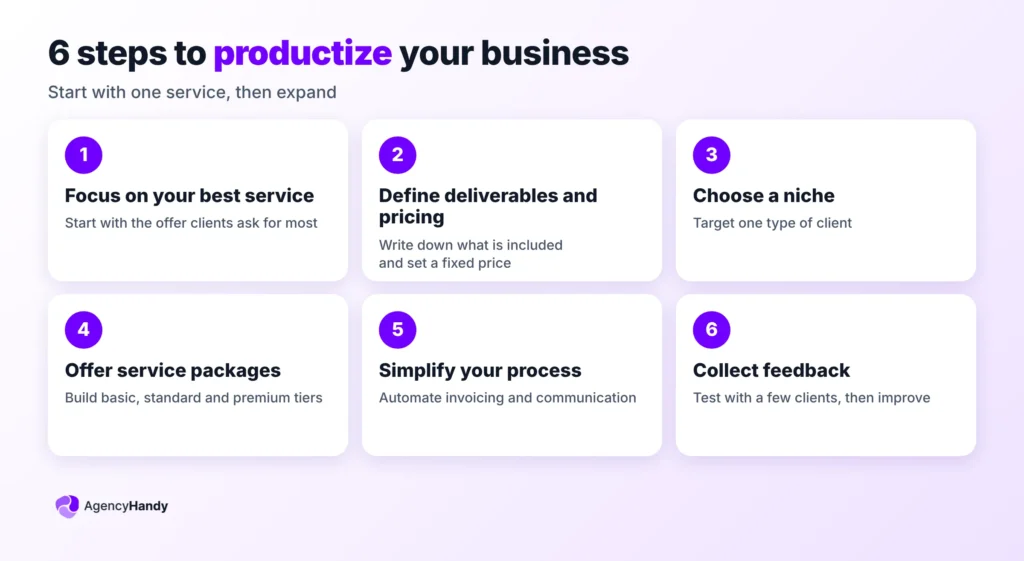
Step 1: Focus on Your Best Service
Start with the service you’re best at and clients request most often. Don’t productize everything at once. Stick to your strongest offering first and expand later.
Step 2: Define Deliverables and Pricing
Be clear about what clients get, like “10 blog posts per month,” and set a fixed price for those deliverables. This avoids confusion and attracts clients who value transparency.
Pro Tip: You can try tiered pricing to attract clients with different budgets while standardizing your services.
Step 3: Choose a Niche
Pick a niche to stand out and target your ideal clients. Specializing helps you refine your service and create focused marketing campaigns.
Step 4: Offer Service Packages
Create tiers to serve different client needs, like basic, standard, and premium options. Tiers help you upsell and meet varying budgets.
Step 5: Simplify Your Process
Use tools and workflows to automate tasks like invoicing and communication. This saves time and keeps delivery consistent.
Step 6: Collect Feedback
Test your service with a few clients, collect their input and make improvements. Regular feedback helps you stay competitive and meet client expectations.
How Do You Productize Yourself?
To productize yourself is to package your skills as a defined offer with a set price, instead of selling your time by the hour. A designer might sell a brand kit, a coach a fixed program and a developer a monthly maintenance plan.
The prices below are examples, not benchmarks. For a starting point, see our list of service business ideas.
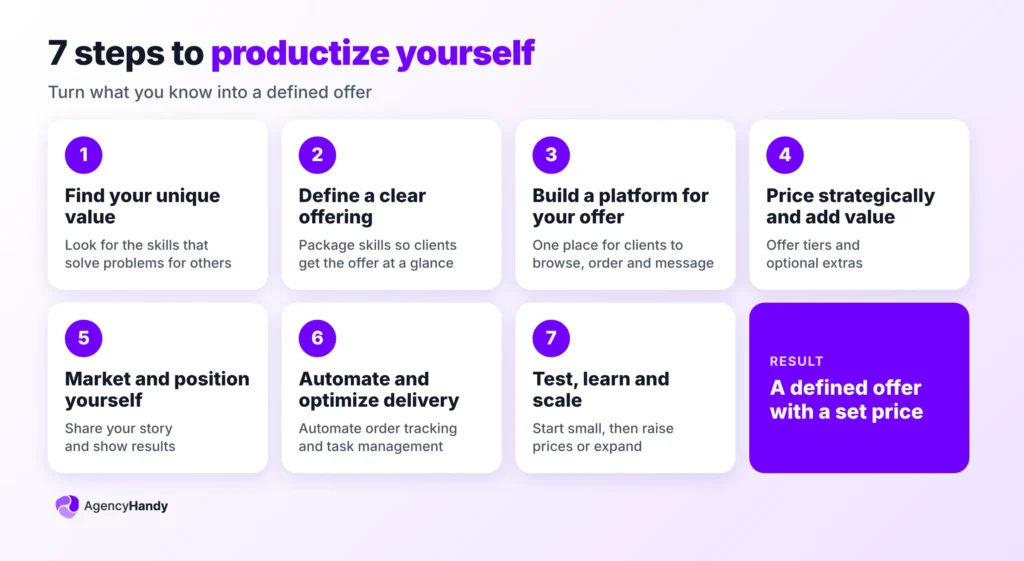
1. Find Your Unique Value
Look for what makes you stand out. Whether you’re a designer, social media expert, or yoga instructor, focus on the skills that solve problems for others.
Think about small business ideas, like what you’re consistently praised for or what clients often come to you for. For example, if you’re a social media expert, it could be your ability to create viral campaigns that drive engagement.
2. Define a Clear Offering
Package your skills so clients can understand them at a glance. Instead of offering vague services, create something specific, like a “Social Media Content Plan” for $500, which includes five pre-scheduled posts.
Clear deliverables make your process simpler and help clients trust and choose your services with confidence.
3. Build a Platform for Your Offer
To sell your services effectively, you need a platform that’s easy for both you and your clients. A tool like Agency Handy lets you set up a customizable client portal. Clients can browse your services, place orders and message you there.
With a clean, white-labeled design, the platform helps you create a professional image that builds trust with your clients. Everything stays organized in one place. That makes it easier to manage your business and gives clients a smooth experience.
4. Price Strategically and Add Value
Set prices that reflect your expertise while offering value to clients. Create tiered packages to fit different needs. For instance, a “Basic Social Media Plan” at $500 and a “Premium Plan” at $1,500 with advanced analytics and scheduling.
Include optional add-ons to upsell, such as faster delivery or customized reports, giving clients more flexibility while increasing your revenue.
5. Market and Position Yourself
Your personal brand is key to attracting clients and standing out. Share your story and expertise through social media, blog posts, or email campaigns. Let your audience see what makes you unique and how you can help them.
Position yourself as the solution to their problems. Use testimonials, case studies or practical tips to show the value you bring. When people see the results you’ve delivered, they’ll be more likely to trust and choose you.
6. Automate and Optimize Delivery
Make your work easier by automating repetitive tasks like order tracking and task management. Automation saves time and keeps your clients’ results consistent and on time.
7. Test, Learn, and Scale
Start small with a few clients. Ask them for feedback and use it to improve your services. Fix any gaps and fine-tune your process based on what works best.
Once you feel confident, take the next step. Raise your prices, expand your services, or enter new markets. Keep testing and learning so your business can adapt and grow as you reach more clients.
What Should You Do Next?
To productize is to give an offer a fixed scope, a set price and a repeatable way to deliver it. That’s the whole idea, and the rest is detail. Once the offer exists, selling gets faster and you stop quoting from scratch. Delivery gets easier to repeat, and clients know what they’re buying.
This week, pick your best-selling service and write down what clients get, what it costs and how long it takes. If that takes more than one page, the offer isn’t ready yet. Then ask one past client what’s unclear.
FAQs
Is productize a word?
Yes. Wiktionary and Cambridge Dictionary both list productize as a verb. It’s common in business and software writing, but a general reader may not know it. Give a short definition the first time you use it, and keep one spelling throughout the page.
What is another word for productize?
Package, standardize, and commercialize come closest, depending on the context. Package fits services, standardize fits processes, and commercialize fits ideas or prototypes. None of them says fixed price, which is why people keep using productize. Choose it when price and scope are part of the point.
What is the meaning of productize vs. productionize?
Ask who the offer is for. If a customer pays for it, you productized it. If it has to run live without breaking, you productionized it. Productize is a business word about selling, and productionize is an engineering word about running software or models in production.
Is productization suitable for businesses that rely on long-term client relationships?
Yes, it works well. Subscription-based or tiered packages help you maintain ongoing partnerships. These models give clients steady value, simplify operations and keep them engaged over time. Set the scope per month so each renewal covers the same deliverables, and clients can upgrade a tier instead of renegotiating.
Can I use a hybrid model combining productized and custom services?
Yes, a hybrid model works well. Standardized offers handle the repeatable work, while custom projects serve premium clients. This lets you meet specific needs without losing efficiency in your core operations, as long as you price the custom work separately.
How do I protect my intellectual property when productizing knowledge-based services?
You can protect your work by using contracts or terms of service agreements that outline usage rights. Clearly define how clients can use your tools or methods, and consider trademarks or copyrights for extra legal protection. Put those terms in writing before your first sale. Rules differ by country, so check with a lawyer in your region.
roductization is a transformative approach that allows you to structure your services as standardized, repeatable, and scalable offerings. You can design service packages with clear deliverables and fixed pricing, just like selling a product off the shelf.
You can even apply the concept to your own expertise and productize yourself, making your skills marketable and scalable. For example: pre-defined consulting sessions, creating online courses, or launching subscription-based content.
In this article, we’ll define productization, explore its benefits, and share actionable steps to help you productize your services and more.
What is Productization?
Productizing is the process of transforming any offering—services, expertise, or even processes—into structured, repeatable, and scalable products.
Instead of creating customized solutions for every customer, you develop standardized packages with clearly defined features, fixed pricing, and predictable outcomes. This approach simplifies sales, helps clients instantly grasp the value, and streamlines delivery through automation.
The primary goal of creating a productized service is to maintain efficiency and profitability while minimizing the unpredictability of custom work. It’s a strategy to address market challenges, such as the volatility faced by 76% of client management leaders, according to the 2023 SoDa report.
In essence, productizing enables businesses to move away from unpredictable, labor-intensive customization. By offering clear, repeatable solutions with defined outcomes, companies can streamline operations, improve client satisfaction, and enhance profitability.
Example of Productization
Now, to explain the concept better, here are examples of productizing different types of offerings.
Productizing Services
Instead of handling every project as a custom job, you can standardize your offerings into clear, easy-to-understand packages. For example, a design agency might create a “Logo Design Essentials Package” that includes three logo concepts, one round of revisions, and a final design file.
You can also offer tiered packages to meet different client needs. For instance, an “Advanced Branding Package” could include everything from the essentials plus extras like business cards and social media templates.
Productizing Processes
You can turn your proven processes into scalable, subscription-based tools that deliver value to many clients at once.
For example, a marketing consultant could offer a monthly subscription toolkit. It might include step-by-step email marketing templates, ready-to-use social media calendars, and performance-tracking dashboards.
This approach makes your expertise available to more clients without the need for one-on-one consultations. It saves you time while providing clients with the resources they need to succeed.
Productizing Expertise
you can turn your skills into a structured solution that reaches more people and adds value. For example, a yoga expert could transform their one-on-one sessions into an online course like “Yoga for Busy Professionals.” This 12-week program might include guided video lessons, downloadable schedules, and bonus mindfulness exercises.
The course could be sold as a one-time purchase or offered as a subscription that includes live monthly workshops or fresh routines. By productizing their expertise, the yoga expert can connect with a global audience and provide a repeatable, high-impact solution.
Exploring more examples of productized services can help you understand how to apply this approach to your own offerings. It’s a practical way to start creating scalable, effective solutions.
Why Should You Try Productizing?
Productized business model can revolutionize service delivery. Standardizing offerings into fixed-price packages eliminates scope creep, boosts efficiency, ensures predictable revenue, and speeds up closing.

1. Speed Up Client Closings
Clients find it easier to buy services like website design or SEO audits with one click. They avoid the hassle of contacting providers, sharing project details, and waiting for quotes. This makes it faster for you to start the project with less back-and-forth communication.
2. Predictable Revenue
With fixed pricing or subscription models, productized services ensure consistent income. This financial predictability makes it easier to manage cash flow and plan for future growth.
3. Increased Profit Margins
Productized service software offerings reduce costs associated with customization and delivery, allowing you to achieve higher profitability on each sale.
According to AgencyAnalytics, you can expect a 30-40% rise in your profit margins after implementing productization.
4. Reducing Scope Creeps
Productization helps avoid scope creep by clearly defining the service scope, deliverables, and pricing upfront.
With standardized packages, clients know exactly what they are paying for and what is included. This leaves no room for misunderstandings or additional requests outside the agreed terms.
Scope creeps are a sign of inefficient operations and that can cost businesses a 20-30% loss in revenues annually.
5. Improved Client Experience
Clear deliverables, transparent pricing, and defined processes eliminate ambiguity. Clients know exactly what they’re getting, leading to better satisfaction and trust.
How to Productize Your Business
Productizing your business offerings involves a clear strategy to transform your expertise into a repeatable, scalable offering. Here’s a step-by-step guide on how to productize a service to create a fail-safe productization plan.

Step 1: Focus on Your Best Service
Start with the service you’re best at and the client’s request most often. Don’t try to productize everything at once—stick to your strongest offering first and expand later.
Step 2: Define Deliverables and Pricing
Be clear about what clients get, like “10 blog posts per month,” and set a fixed price for those deliverables. This avoids confusion and attracts clients who value transparency.
Pro Tip: You can try tiered pricing to attract clients with different budgets while standardizing your services.
Step 3: Choose a Niche
Pick a niche to stand out and target your ideal clients. Specializing helps you refine your service and create focused marketing campaigns.
Step 4: Offer Service Packages
Create tiers to serve different client needs, like basic, standard, and premium options. Tiers help you upsell and meet varying budgets.
Step 5: Streamline Your Process
Use tools and workflows to automate tasks like invoicing and communication. This saves time and ensures consistent delivery.
Step 6: Collect Feedback
Test your service with a few clients, gather their input, and make improvements. Regular feedback helps you stay competitive and meet client expectations.
How to Productize Yourself: A Step-by-Step Guide
Productizing yourself is about taking what you’re already great at and transforming it into structured offerings that save time, attract clients, and grow your income. Here’s how to get started with your service business ideas —

1. Discover Your Unique Value
Identify what makes you stand out. Whether you’re a designer, social media expert, or yoga instructor, focus on the skills that solve problems for others.
Think about small business ideas, like what you’re consistently praised for or what clients often come to you for. For example, if you’re a social media expert, it could be your ability to create viral campaigns that drive engagement.
2. Define a Clear Offering
Turn your skills into straightforward packages that clients can easily understand.
Instead of offering vague services, create something specific, like a “Social Media Content Plan” for $500, which includes five pre-scheduled posts.
Clear deliverables make your process simpler and help clients trust and choose your services with confidence.
3. Build a Platform for Your Offer
To sell your services effectively, you need a platform that’s easy for both you and your clients. A tool like Agency Handy lets you set up a customizable client portal where clients can browse your services, place orders, and communicate with you effortlessly.
With a clean, white-labeled design, the platform helps you create a professional image that builds trust with your clients. Everything stays organized in one place, making it easier to manage your business while offering a seamless experience for your clients.
4. Price Strategically and Add Value
Set prices that reflect your expertise while offering value to clients. Create tiered packages to cater to different needs. For instance, a “Basic Social Media Plan” at $500 and a “Premium Plan” at $1,500 with advanced analytics and scheduling.
Include optional add-ons to upsell, such as faster delivery or customized reports, giving clients more flexibility while increasing your revenue.
5. Market and Position Yourself
Your personal brand is key to attracting clients and standing out. Share your story and expertise through social media, blog posts, or email campaigns. Let your audience see what makes you unique and how you can help them.
Position yourself as the solution to their problems. Use testimonials, case studies, or actionable tips to show the value you bring. When people see the results you’ve delivered, they’ll be more likely to trust and choose you.
6. Automate and Optimize Delivery
Make your work easier by automating repetitive tasks like order tracking and task management. Automation saves time and ensures your clients get consistent, on-time results.
By simplifying your process, you can focus on delivering quality and scaling your services without feeling overwhelmed. Efficiency is key to growing your business smoothly.
7. Test, Learn, and Scale
Start small with a few clients. Gather their feedback and use it to improve your services. Fix any gaps and fine-tune your process based on what works best.
Once you feel confident, take the next step. Raise your prices, expand your services, or enter new markets. Keep testing and learning so your business can adapt and grow as you reach more clients.
Final Thoughts
Productization offers a straightforward way to simplify your work, attract more clients, and grow your business sustainably.
By turning your expertise into clear, repeatable offerings, you can eliminate inefficiencies and provide a better experience for your clients. At the same time, you’ll benefit from more predictable income and less stress.
Whether you’re a freelancer, agency owner, or running a startup, productizing helps you focus on what matters most—delivering value to your clients—while spending less time on administrative tasks.
It’s a smart way to grow while keeping things manageable and efficient.
FAQs
Is productization suitable for businesses that rely on long-term client relationships?
Yes, it works well. Subscription-based or tiered packages help you maintain ongoing partnerships. These models provide consistent value, streamline operations, and keep clients engaged over time.
How do I protect my intellectual property when productizing knowledge-based services?
You can protect your work by using contracts or terms of service agreements that outline usage rights. Clearly define how clients can use your tools or methods, and consider trademarks or copyrights for extra legal protection.
Can productized services work for seasonal businesses?
Yes, they can. Create off-season packages or recurring subscriptions to keep clients engaged throughout the year. This helps maintain steady cash flow and prepares clients for peak seasons.
How do I handle service scalability during sudden demand surges?
Use automation for repetitive tasks, bring in freelance support for short-term help, or create waitlists to prioritize clients. These strategies help maintain quality without overwhelming your team during busy periods.
Can I use a hybrid model combining productized and custom services?
Yes, a hybrid model works well. Standardized services provide scalability, while custom solutions cater to premium clients. This lets you meet specific needs without losing efficiency in your core operations.
What is the meaning of productize vs. productionize?
Productization means turning a service into a scalable, standardized product. Productionize focuses on optimizing systems or processes for mass production. While both aim for scalability, productizing targets your offerings, and productionizing focuses on operational efficiency.