Skip to content
  Get the best 3-year deal NOW →
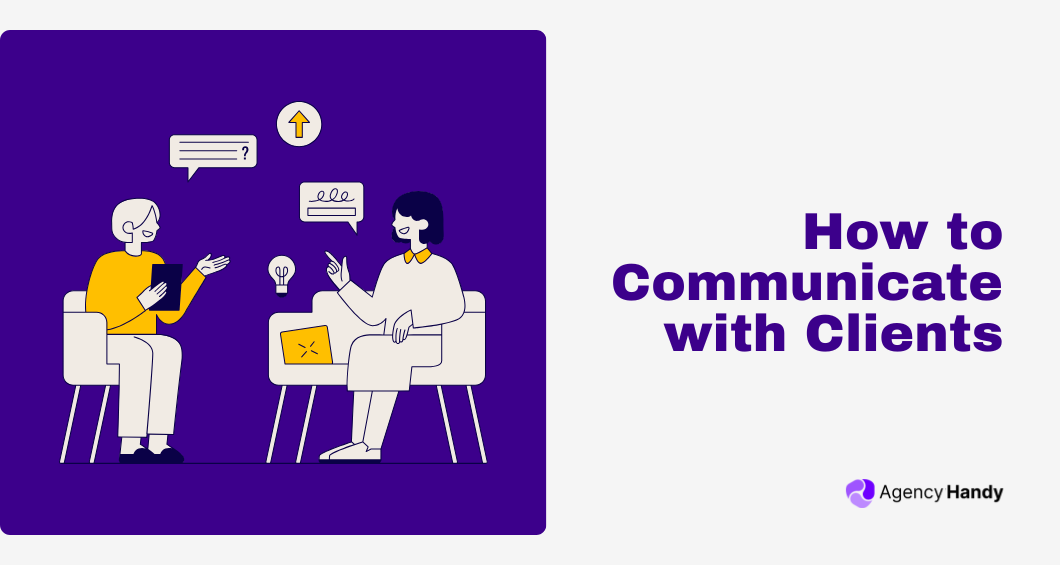



51% of clients stay when they are satisfied, according to Grammarly. And effective client communication is the key to client satisfaction according to another study done by Academia.
Communication is the only language that would make your clients understand. Sometimes what happens is that agencies miss deadlines, but they maintain good communication; that’s why clients retain.
But when you’re scaling your business, that communication doesn’t only limit to chats, sending updates, and submitting deliverables. You need to centralize the communication so that you don’t spend too much time on it, and also, clients feel that they are heard.
From this article, you will get an idea of why client communication matters for agencies and digital businesses, and how to improve it using modern communication tools focused on agency operations.
What is Client Communication?
Client communication is the exchange of information between an agency and its client in a systematic way. It can happen during onboarding, project delivery, billing, and support. Basically, it’s the process of maintaining consistent communication through fixed channels.
However, it takes time and effort to improve client communication skills. Plus, an agency should be aware of its shortcomings, work to improve them, and apply best practices.
What are the Risks of Poor Client Communication for Agencies?
Poor client communication has a direct cost. Here’s what happens when you get it wrong —
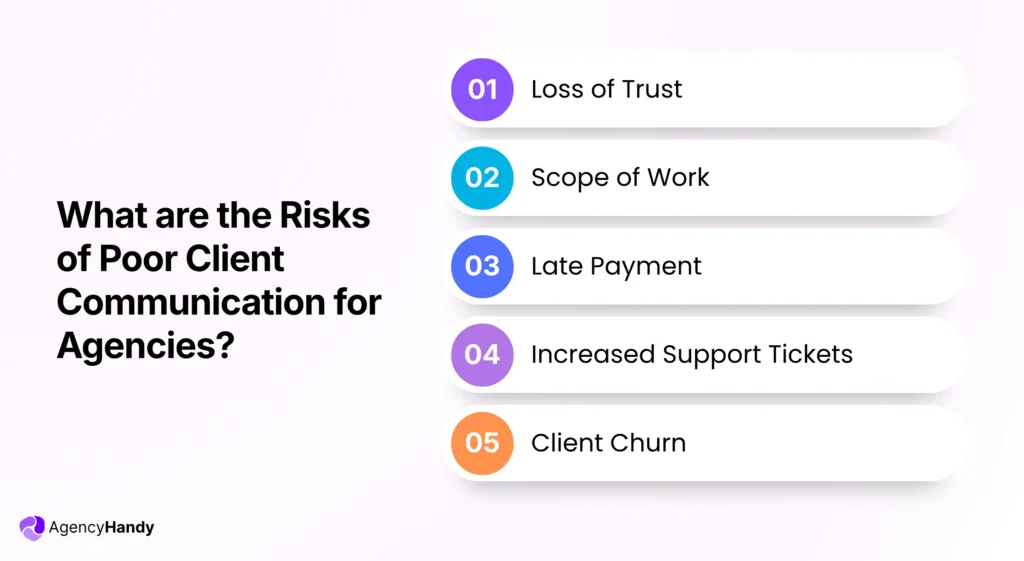
- Loss of Trust: Clients notice when updates are inconsistent. They start questioning your work, even when the work is fine. Trust is hard to rebuild once it’s gone.
- Scope Creep: When you don’t clearly explain deliverables and exclusions upfront, clients expect things you never agreed to. That turns into a conflict mid-project.
- Late Payments: Clients who feel ignored delay payments. If they don’t understand what they’re paying for, they’ll question the invoice before approving it.
- More Support Tickets: When clients don’t get regular updates, they raise tickets just to know what’s happening. That’s extra work your team shouldn’t be doing.
- Client Churn: All of the above compounds. A client who doesn’t trust you, doesn’t understand the scope, and keeps raising tickets will eventually stop working with you.
Why Most Agencies Fail in Client Communication?
Grammarly found that skilled team members spend 88% of their week just informing people across different channels. That sounds more like admin work than client communication.
Here’s where most agencies go wrong —
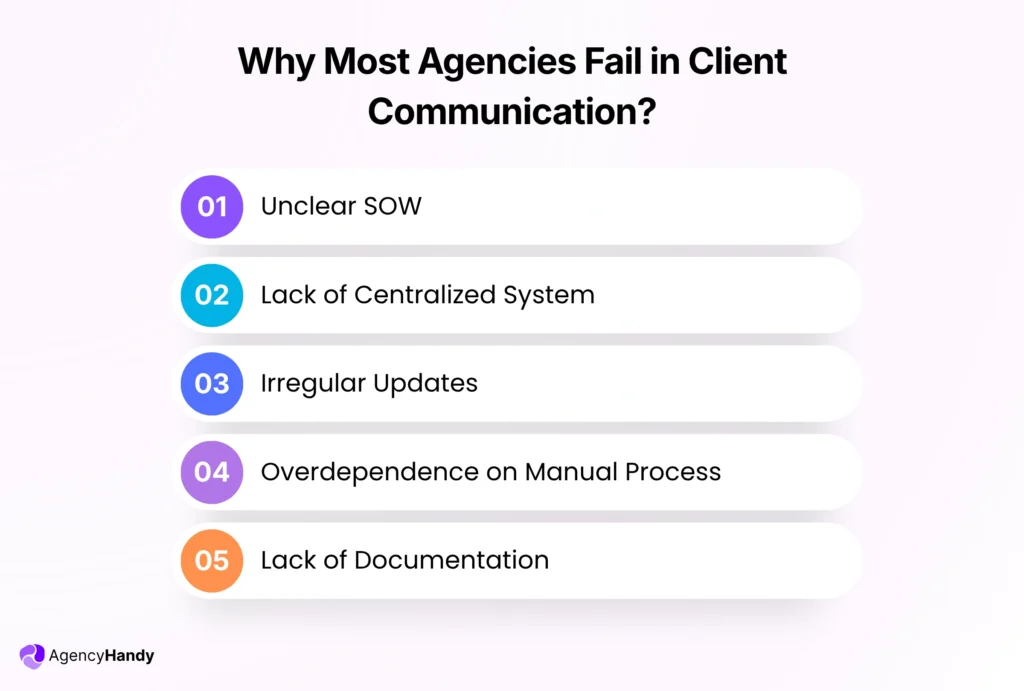
Unclear Scope of Work
Agencies often start projects without clearly explaining what’s included and what isn’t. Clients fill in the gaps themselves. If you fail to explain the deliverables, inclusions, and exclusions, the client might expect the unexpected.
In the end, it’ll create conflict, and you might even lose the project.
Lack of Centralized System
Most agencies still run client communication across email, WhatsApp, and Zoom. There is no single place where everything lives. Eventually, important details get missed, and conversations get lost. Your team ends up answering the same questions repeatedly.
Irregular Updates
Agencies’ delay in providing regular updates right after client onboarding. They provide one update this week and go silent for the whole month. At this point, clients don’t feel that you can professionally deal with them on projects.
Overdependence on Manual Process
When you do things manually, you need to keep all data and information in a spreadsheet, and even worse, in your mind. And that often leads to missing information.
If the project manager forgets to provide an update, falls sick, or takes leave, then communication stops. It becomes frustrating for both your team and clients.
Lack of Documentation
Verbal agreements without a written record cause problems. Client feedback gets missed. Teams repeat work. Payment terms get disputed. Even after a call, document what was discussed and confirm it with the client.
How Agencies Can Improve Client Communication?
Agencies can improve client communication style by following the given steps —
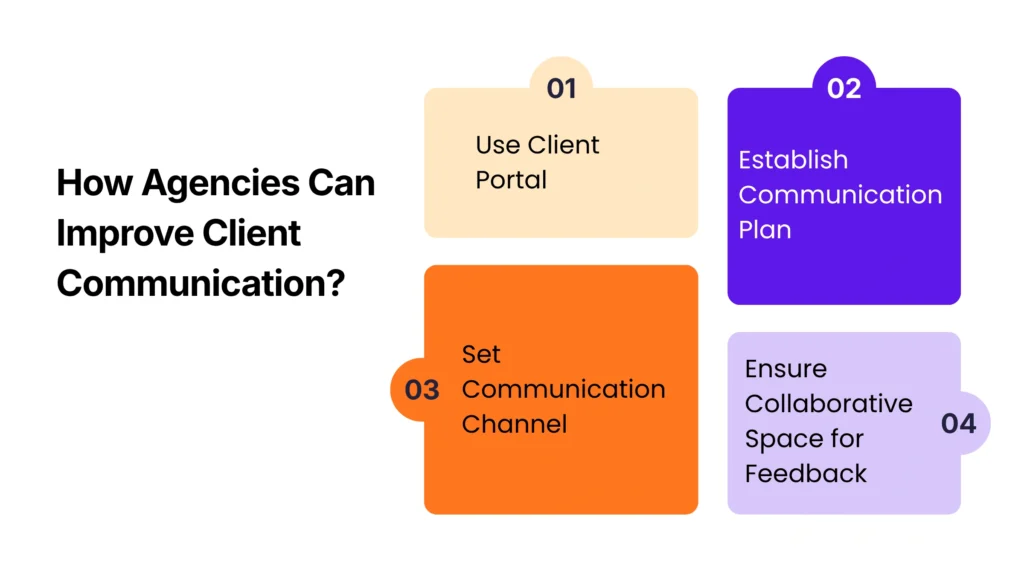
Use ClieUse Client Portal
A client portal keeps all client communications in a single place, be it a query or anything related to an ongoing project. Every conversation, file, update, and invoice is tied to the client and the project it belongs to.
Clients log in and check project status, review files, give feedback, and pay invoices, all from the same workspace. Your team doesn’t have to give project updates every once in a while.
For agencies managing multiple clients at once, this is where client portal pays for itself. It handles several client-end hassles on its own, and lets your team work on billable hours.
Further Read:
Client Portal Software: Manage Clients & Projects in A Branded Workspace
Establish Communication Plan
Ask your clients what their preferred ways of communication are. That’s because even with a client portal, it’s best to create and share a solid plan for effective communication with clients.
In this case, you can create a weekly, monthly, and even a quarterly plan. In the plan, you’ll clearly state the time for regular check-ins and review meetings with your client.
This way, clients will know exactly when they’ll get the updates, the next steps, and have confidence in you.
Set Communication Channel
52% of customers demand a quick reply to their requirements, problems, or recommendations, says the CMO Council survey. To meet expectations, you must define effective communication channels for clients.
Explain where the day-to-day conversation will take place, like Slack, email, or the built-in chat tool. Hence, it’ll keep communication organized and remove any uncertainty.
Ensure Collaborative Space for Feedback
Feedback is also another key part of client communication. And it’s obvious!
Ensure clients can share feedback on your team’s work. They should be able to open a file and leave comments or share notes as needed.
That way, clients can skip taking dozens of screenshots and share them on WhatsApp to highlight something. Additionally, it reduces the risk of misinterpretation.
Implement Suggestions from Client
See, there is always room for improvement in almost anything. That’s why, directly ask the client if they’ve been facing any challenges and what can be improved.
You can also create a questionnaire and send it to clients. For example —
- Do you have any recommendations for smooth communication?
- Is there any communication method we should use?
- What are the top 3 things we need to improve regarding client communication?
- What are your suggestions for communicating with our internal team?
But, the questions will vary depending on your business model.
And based on their feedback, try to improve the way of conversation with your clients. Besides, it also shows that you care about your clients. In return, it also increases customer loyalty.
Client Communication Best Practices for Agencies
Agencies must follow the best practices for client correspondence. It helps to reduce the risk and increase client retention. In this case, ensure that you apply the following to your agency.
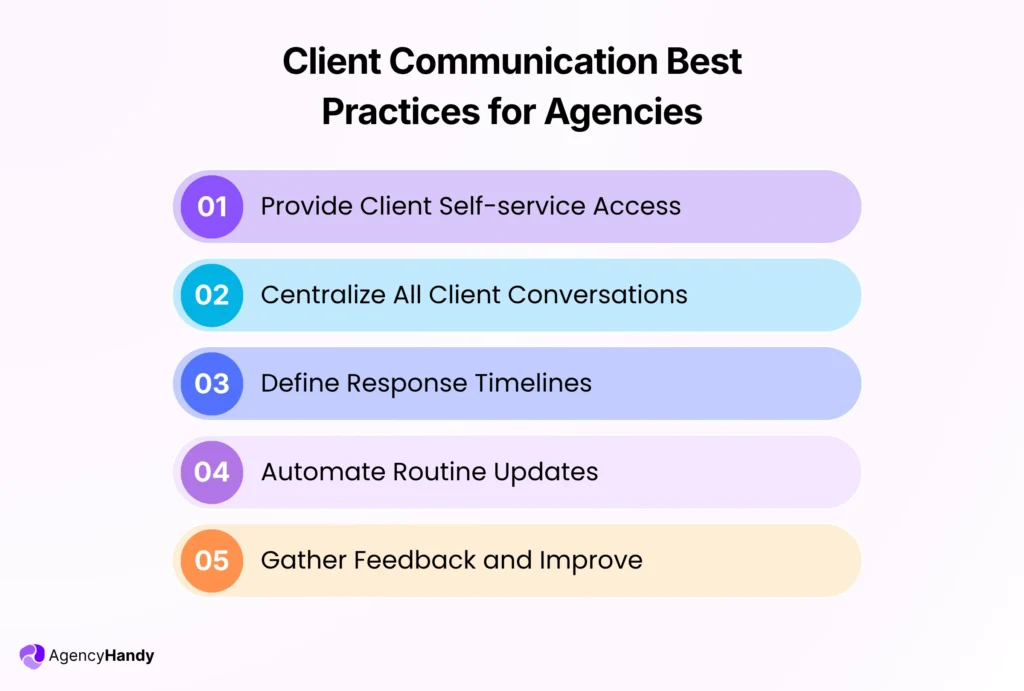
Provide Client Self-service Access
You should offer clients self-service access via a client portal. That way, your client will be able to see the work progress without sending you the “What’s the update?” message.
A client portal also allows for sharing feedback, version control, annotation, leaving notes, and even drawings. Hence, clients can skip scheduling a video call just to show the fixes they require.
On top of that, Agency Handy gives you access to attachments directly within the platform. Overall, that’s how a single portal simplifies client communication without needing your assistance.
Centralize All Client Conversations
It often happens that you spend hours scrolling through chats, emails, and jump between Slack and WhatsApp to find a conversation. That’s a bad practice! And this is why you must centralize all the conversations.
Here, an agency management software can help. It links every interaction from uploads, support tickets, to invoices with a single client profile.
This way, conversations stay in one place. Plus, it reduces miscommunication and the need to ask clients unnecessary questions.
Define Response Timelines
Give your clients a specific time for when they’ll get your response. They shouldn’t ask questions and spend hours waiting for your answer. It’ll make them anxious and confused about your service.
For instance, you can set a specific time, like 10:00 AM, in the morning to inform the whole day’s planning. Then, you set a time in the afternoon to answer any queries from your clients. It’s just a surface-level example; you should redefine the timeline based on your business.
Automate Routine Updates
You should know how many updates and details your clients want from you regularly. With that information, select software to automate project updates. It should also generate reports and send payment reminders to clients.
Thus, your team members don’t need to rely on their memory to offer key updates. Likewise, a client portal plays a fantastic role here by providing a space to view project progress, dues, pending items, and invoices.
This way, clients feel satisfied as they get critical information without the constant “check-in” calls.
Gather Feedback and Improve
Remember, client communication is an ongoing process, and you can always improve your client communication skills. And the best way to do that is by gathering feedback from the clients.
You can ask —
- How fast do you get answers when you contact us?
- Do you get proper information about your project?
- Are we able to provide you with clear updates?
- Would you suggest any other channel of communication?
- What’s the one thing we should improve in communicating with you?
What are the Different Stages of Client Communication for the Agencies?
Communication looks different at each stage of the client journey. Here’s what to focus on at each one —
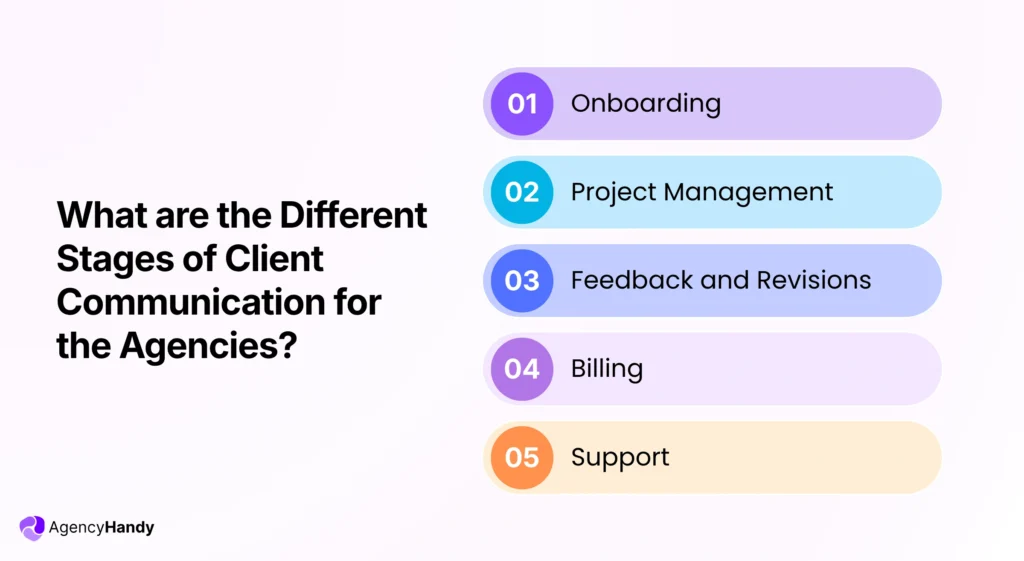
OnbOnboarding
When onboarding a client, it’s the first key step in communicating and establishing trust. This is where your clients get to understand your agency through how you —
- Explain the scope of work, timelines, budgets, and exclusions
- Establish interaction channels
- Offer client-portal self-service access
If you fail to resolve it now, project-specific consequences may follow. Later, it’ll be difficult to correct issues like delayed payments or misunderstandings.
Again, when onboarding is handled properly, clients receive the transparency they need. It helps to keep project discussions efficient and progressing.
Further Read:
Client Onboarding: A Comprehensive Guide for Beginners (+Templates)
Project Management
It’s logically the core part of client communication. Here, you offer structured updates of the project’s deliverables, milestones, bottlenecks, and achievements.
Without transparent project updates, they can’t track the goals and don’t get real value. It makes them curious, anxious, and in doubt during this stage. So, make sure to keep up with your clients regularly.
Further Read:
What is Agency Project Management? [Features, Best Practices, and Examples]
Feedback and Revisions
When offering a service or product, there will be feedback loops and revisions. Thus, your clients should have access to leave their inputs, attach references, leave notes, etc.
Meanwhile, you properly get in touch to explain what’s feasible based on their needs and what the next steps will be.
Right there, Agency Handy comes with an exceptional solution. Clients can open images, PDFs, and videos to comment, draw, and share perspectives on live websites. Plus, it brings version control for ease of tracking and gets back to the previous version as well.
Further Read:
Client Feedback: Importance, Ways to Collect, Manage, and Act on Feedback
Billing
Billing conversations can go wrong when clients don’t understand what they’re paying for. So here, you must communicate transparently to explain the costs, terms of payment, and invoice details.
When clients have portal access to their invoices and payment history, generic billing questions would drop significantly.
Further Read:
How to Bill a Client in 2026: A Step-by-Step Process
Support
Support is a major part of the client experience. You can offer support through different channels, like mobile, text message, video calls, or even emails. It basically depends on your client’s preference.
The key is that they receive solid support from you if they encounter any issues. For example, a client might find it hard to track projects, pay invoices, share feedback, etc.
Also, they might want to hear about the overall progress on your work.
Thus, make sure to establish a proper support system. And don’t forget to show empathy, as 68% of customers now want brands to show compassion in every communication, according to Salesforce.
Final Words
In client communication, set clear expectations. Also, define the deliverables, timeline, payment terms, communication channels, and response times upfront. And avoid using multiple tools as they create more friction rather than improving interaction.
In this case, Agency Handy can simplify the whole process for your agency. It offers a self-service client portal to centralize the communication to manage projects, feedback, ticket support, and payments.
Thus, your clients will get real-time updates and have confidence in your service.
FAQs
Why is client communication important?
Client communication is important as it helps to clarify expectations, deliverables, timelines, and budgets transparently. Meanwhile, it allows the clients to express their goals, challenges, visions, and feedback.
What are three types of communication you can have with a client?
The three types of communication you can have with a client are
- Verbal, including meetings, phone calls, and video calls.
- Written, including messages, emails, contracts, and reports.
- Visual, including dashboards, presentations, charts, and whiteboards.
How often should agencies communicate with clients?
Agencies should communicate with clients depending on the project’s requirements and the client’s needs. However, it’s a good rule of thumb to update key milestones, bottlenecks, or achievements daily. Then, host a monthly meeting to provide a holistic view of the work and ensure a 24/7, reliable support system.