Skip to content
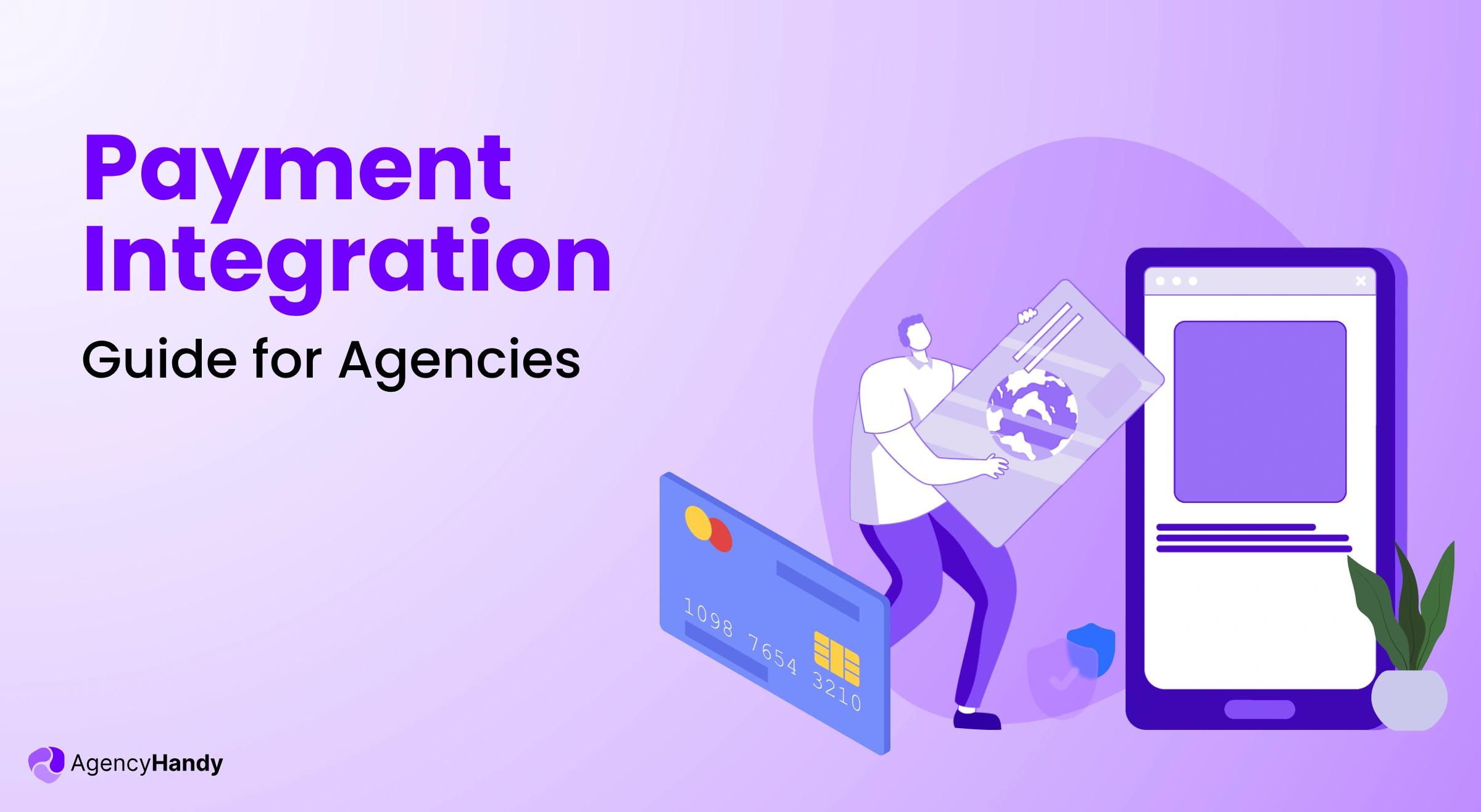



Payment experience matters to retain the existing client base and upsell more services to them. 71% clients are more likely to complete a payment if their preferred payment method is available.
It’s always better to give clients payment gateway options. After all, agencies’ cash flow depends on it. It also increases the client retention rate.
This guide will let you know how to integrate a payment gateway. You will have a clear understanding of how these integration services work.
What is Payment Integration?
Payment integration is the process of how a website’s sales pages to a payment processing system. The system makes sure the client doesn’t have to leave the website to complete payment. It also helps businesses to get clear data on their total sales revenue.
Integrating a payment gateway to your business website lets clients securely send digital payments without the hassle.
A real case scenario would be when someone lands on your sales page, selects services, and checks out. The person will see multiple payment gateways that you have integrated. Then use the most convenient option to complete the payment.
Why Would You Need Payment Integration?
Your business needs payment integration for both business purposes and client convenience. The first and most obvious reason is that you want to get paid for your services. The following are the important reasons that you need to think about –
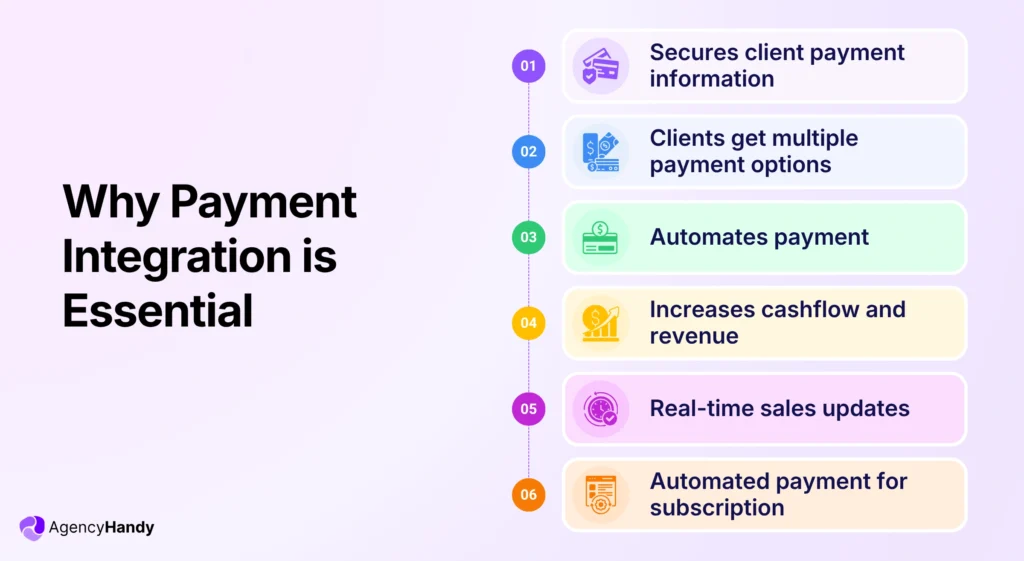
Secures Client Information
A secure integrated payment system protects client information like credit card numbers and other details. People don’t trust a business leaving loopholes for data breaches. People feel discouraged from paying for services when they don’t find secure, integrated payment methods.
Clients Prefer Multiple Payment Methods
10% of clients abandon carts when they don’t see their preferred payment method during the checkout process. Clients always want the easiest and most convenient payment method for services.
63% of clients even want payment options like Apple Pay and Google Pay to pay right from their smartphones.
Automates Payments
Integrated payment automatically charges from clients. Whenever they purchase a service or it’s time for a subscription, the system charges money. No need to manually handle anything related to payments.
Increases Revenue
Payment integration increases business revenue by helping get paid faster. When customers see their preferred payment option, and checkout is simple, they’re more likely to buy. And for subscriptions, the system charges clients even if you forget. It increases cash flow and reduces late payments.
A Secured and Trusted Payment Gateway
Clients want a secure, trusted gateway for payment. According to Baymard, 19% of clients end up abandoning carts during online checkouts due to a lack of security, such as SSL certificates.
Real-time Sales Updates
When payment methods are integrated into the platform, whether an e-commerce site or a CRM, you will see which products or services generate the most revenue.
Automated Payment for Subscription Services
Your clients want a payment processor that automatically charges them for their subscriptions. They don’t want to input their card information every month or every time it’s time to pay.
How Online Payment Integration Works
Payment integration in a website works using several elements, such as the client’s card details, the integrated payment method in the business, the client’s bank, and the business platform or system. Here’s a simple and non-technical breakdown of how it works –
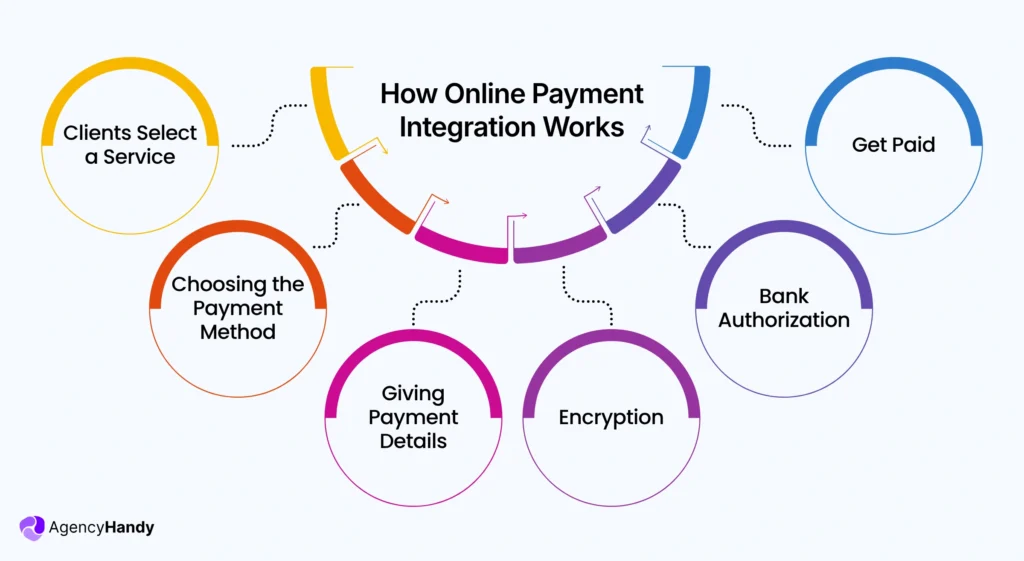
Clients Select a Service
When a client wants any of your services, your website shows multiple payment methods. These methods or payment options are integrated within your business platform. It can be PayPal, Stripe, Wise, a credit card, a manual bank, or even crypto.
Choosing the Payment Method
Your client then chooses the preferred payment method. It can be a credit card or any digital wallet.
Giving Payment Details
The chosen payment method then asks the client to enter the payment details. The person has to type the name, card number, CVV, etc.
Encryption
A secure online payment gateway then encrypts the card’s information securely. This makes sure the information doesn’t leak.
Bank Authorization
The payment gateway then sends the card’s encrypted information to the client’s bank for authorization. The bank checks the details, including name, card number, and CVV, and sends an authorization OTP code to the client.
Once the client inputs the code, the bank sends the requested funds to the merchant’s account.
Get Paid
Within 2-3 working days, the merchant gets the payment in the bank. If the merchant has a digital wallet, the funds are transferred immediately. The business then sends the client a confirmation email notification. The email contains an invoice for that purchase.
Payment Gateway Integration Services vs. Built-In Solutions
When agencies need to accept online payments, they have 2 options.
- Integrate a payment gateway service through a developer. It’s costly and time-consuming.
/ OR /
- Use platforms with built-in payment processing. This is fast and ready to go with agency workflow.
Payment Gateway Integration Services: It requires you to connect third-party payment processors to your existing website or system. This approach involves:
- Hiring developers to integrate a payment gateway into the website
- Paying for custom coding and API setup
- Ongoing maintenance and security updates
- Managing multiple systems separately (CRM, invoicing, payment gateway)
- Higher upfront costs for technical implementation
This gives you complete control over customization. But it’s time-consuming and expensive for small to mid-sized agencies.
Built-In Payment Solutions: Agency platforms like Agency Handy offer integrated payment processing within an all-in-one platform. You get:
- Pre-configured payment gateway integration (Stripe, PayPal, Wise, crypto)
- No coding or technical expertise required
- Automatic security updates and PCI compliance
- Unified system for CRM, invoicing, and payments
- Lower total cost with subscription-based pricing
You can start accepting payments immediately. No coding or developers are needed to integrate the payment gateway into the website. From client onboarding to project delivery to getting paid, everything works together seamlessly.
How Agency Handy Helps in Payment Integration for Agencies
Agency Handy, as a subscription management software, comes with an integrated payment system. Clients can purchase services and complete payment. The platform then helps agencies to manage subscriptions and projects for each purchased service.
Here’s a simple breakdown of the entire process –
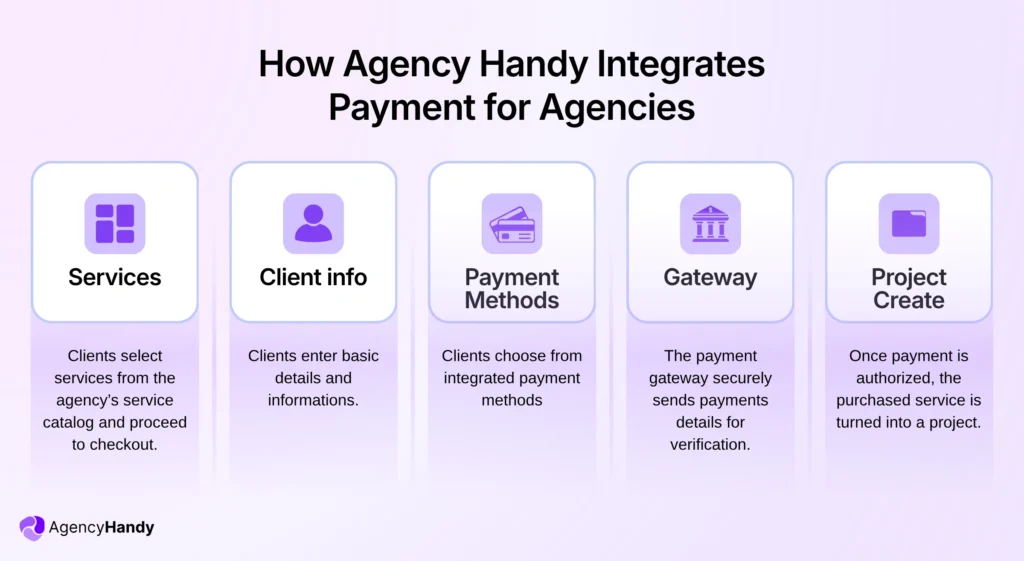
Clients Select Services from Catalog
Create a catalog of the services you provide as an agency. Prospects or existing clients select the services they want to buy and proceed.
Client Gives Payment Details
Clients have to give some basic information like their name, company name, email, zip code, etc. and proceed to the payment.
Integrated Payment Methods
Clients see a list of integrated payment methods. They can use Stripe, PayPal, Wise, Crypto, and a manual bank. They give the necessary card details to the gateway, like their name, card number, and CVV.
Gateway Reaches the Bank
The gateway then reaches the bank linked to the client’s card. Reaches directly to digital wallets when clients want to pay from Stripe, PayPal, and Wise.
Bank Authorizes
The client’s bank authorizes the payment and transfers the requested funds to your business account.
Clients Get a Notification
Clients get a notification of the purchased services. It gets listed on the project tool as well, from which they can track real-time project updates.
Frequently Asked Questions
What is payment integration on a website?
Payment integration connects your website to a payment processor. It allows customers to complete transactions directly on your site. It handles credit cards, digital wallets, and other payment methods. The system securely handles payment without redirecting users elsewhere.
Is payment integration secure?
Reputable payment processors use encryption and PCI compliance standards. It’s to protect sensitive payment data. Look for processors with strong security certifications and fraud protection.
Why do agencies need payment integration?
Payment integration automates invoicing. It also speeds up collections and provides clients with a seamless payment experience. It reduces manual work and helps you get paid faster with fewer follow-ups.
How much do payment integrations cost?
Most charge 2-3% per transaction plus a small flat fee. Some platforms include payment processing in their subscription. While others partner with third-party processors.
Can I track revenue by service type?
Payment integrations provide reporting dashboards. It breaks down revenue by service category, client, payment method, and time period. It shows better financial insights and forecasting.
What if a client’s payment fails?
Most integrations automatically retry failed payments. The system sends dunning emails to clients and notifies you of issues. You can pause services or update payment methods before canceling subscriptions.
Final Words
Payment integration for your agency would require you to hire developers and incur ongoing maintenance costs. With Agency Handy, you don’t have to think about it. The platform comes with multiple payment integration methods that people rely on and trust.
Start your free trial and simplify your agency’s billing today.