Skip to content



When it comes to service pricing, most agencies start with competitor rates or gut feel. Well, months later, they realize that they’ve been undercharging while overdelivering.
Practically, pricing works best when your service has a defined scope and a clear deliverable. Also, it must have a structure that clients can evaluate before they commit.
That said, today, we’ll cover the main pricing models for productized agency services. You’ll also know how to calculate your real cost of delivery, and when to adjust your rates.
What Pricing Models Work Best for Productized Agency Services?
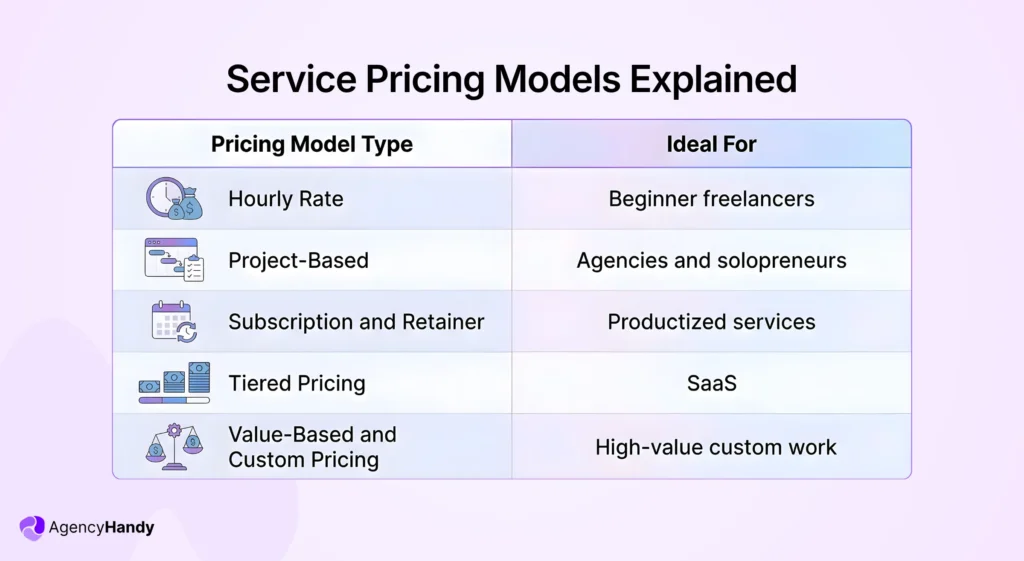
You need to pick a pricing structure that fits your deliverables. Most productized services and SaaS businesses use one of the following models or combine a few based on the situation.
To see how these pricing models fit into a broader service delivery system, read Productized Service Software: Definition, Benefits, Top Software & More.
Hourly Rate Pricing
This pricing model bills clients based on the time tracked. Let’s say you worked on a project for 10 hours, the rate is $100/hour, your payment would be $1,000.
You’re only limited to your billable hours.
When Hourly Works: The model is suitable if you’re providing services in the initial stage of your career. This model has no clear scope, and clients keep changing their requirements. So, it often causes repeated work and endless revision.
Project-Based Pricing
For this service pricing model, you set a fixed price for a defined deliverable within a fixed timeline. You charge a regular rate for whatever project you do. It doesn’t matter how many hours you have to work on it.
When Project-based Works: This model suits best for one-time deliverables with clear boundaries. Website builds, brand identity packages, product launches, and campaign development are ideal to charge on a project basis.
Subscription-Based Pricing
With subscription pricing, clients pay a recurring monthly fee for a defined set of deliverables. Here, the output is fixed, the schedule is fixed, and billing runs automatically every cycle.
For agencies, this model creates predictable monthly revenue. However, the one condition that makes or breaks it is scope definition. Clients need to know exactly what the subscription covers and what it doesn’t.
When Subscriptions Work: Ideal for ongoing services like content production, social media management, SEO, technical maintenance, or anything requiring continuous delivery.
If you want a deeper look into how to structure and price recurring service tiers, explore Subscription-Based Pricing for Agencies: Models, Setup, and Mistakes.
Tiered Pricing (Good-Better-Best)
Tiered pricing structures your service into 3 or 4 levels. Each tier has a defined scope and price point —
- Entry tier: core deliverables, lowest price point
- Mid-tier: expanded scope, more output, or faster turnaround
- Premium tier: full package plus priority handling or extended support
The model works through price anchoring. In fact, most clients land on the middle tier. It avoids the risk of the cheapest and the excess of the most expensive. That makes your mid-tier the highest-volume plan by default.
That said, each tier needs a clean scope boundary. So, you must
- Define what it delivers
- Set revision limits
- Separate support levels
When Tiered Pricing Works: Perfect for productized services where you can clearly differentiate service levels. It works especially well for agencies moving from custom quotes to repeatable service structures
Value-Based and Custom Pricing
For value-based pricing, you have to set prices based on the outcome value. If your brand strategy helps a client raise $1 million, you can ask for $10,000.
As for the custom pricing, it means you create a unique quote for each client. It’d be based on their specific situation, budget, and the value you’ll create.
When Custom Pricing Works: Best for strategic, high-impact work where you can specify the ROI. Consulting, brand strategy, business transformation, and specialized technical implementations fit here.
How to Price the Service of Your Agency
Before setting your price, calculate what it actually costs to deliver the service. Most agencies skip this and base rates on competitors, and that’s how undercharging starts.
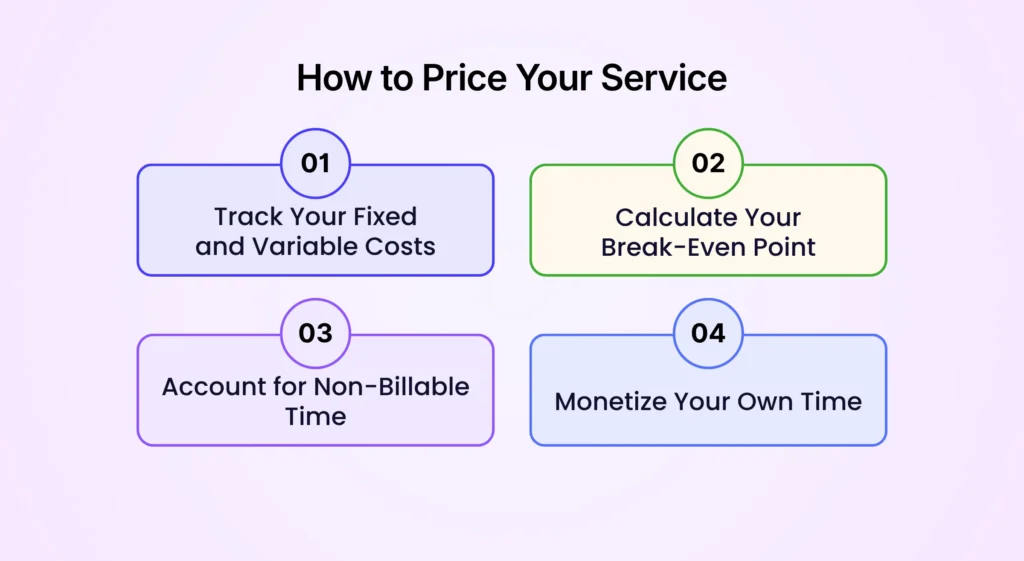
Track Your Fixed and Variable Costs
Split every expense into two categories before you set a single price —
Fixed Costs
They’re the same every month, regardless of workload —
- Employee salaries
- Office rent or coworking space
- Utilities and internet
- Insurance premiums
- Equipment and maintenance
Variable Costs
These can change based on project type and volume:
- Software and tool subscriptions
- Payment processing fees (2-3% adds up fast)
- Marketing and advertising spend
- Contractor or freelance support
Calculate Your Break-Even Point
Once you know your monthly costs, calculate how many projects cover them.
Say your total monthly cost is $4,000. You charge $2,000 per project, and it costs $800 to deliver. Gross profit per project is $1,200. Divide $4,000 by $1,200, and that’s 3.3 projects per month to break even.
Above that number, you’re profitable. Below it, you’re losing money regardless of how busy you feel.
Account for Non-Billable Time
It isn’t that you would always work on billable tasks. There are —
- Prospecting
- Proposal writing
- Admin tasks
- Answering emails
- Updating your website, etc.
You just can’t invoice them.
Say you work 160 hours a month. Only 100 of those are billable. Those 100 hours need to cover the full 160. Price them as if they do, or your effective hourly rate quietly drops every month.
Monetize Your Own Time
One mistake most agency owners make early on is treating their own time as free. They think, “I’m not paying myself yet, so my time costs nothing.” But that’s not how it works. Your time carries value, often more than your team’s.
A better approach is to bill yourself at the market rate for a senior professional doing your job. Then track your actual time on client delivery for 30 days straight. What you’ll find is that tasks almost always take longer than you planned.
How Does Value-Based Pricing Work for Agency Services?
Value-based pricing is about setting your price based on what the client gains. Not what you spend delivering it. If you can convince your clients about the value your work is about to bring, you can actually charge higher for the outcome.
Calculate What Your Client Actually Gains
If you’re to charge based on the value, here’re some questions that would help you get a clear understanding:
Current state questions could be as follows –
- What’s your monthly revenue right now?
- How many leads do you generate per month?
- What’s your current conversion rate?
- What’s your average customer lifetime value?
- Where do you lose the most money or time?
Future state questions could be as follows –
- What happens if this problem isn’t solved?
- What would a 20% improvement be worth to you?
- How much are you spending to fix this yourself?
Let’s say one of your e-commerce clients gets 50,000 monthly visitors with a 2% conversion rate. They do 1,000 sales per month. Their average order value is $100, so they make $100,000 monthly.
If you rewrite their product pages and can boost conversion to 3%, that’d be 1,500 sales or $150,000 monthly. That’s a clear $50,000 increase. You can actually charge $5,000 if you can convince clients to show previous records.
Right Time to Use Value-Based Pricing
Value-based pricing would work only if you can show a clear ROI and a previous track record. It’s ideal for high-impact services like –
- Brand strategy and positioning
- Conversion optimization
- Sales copy and landing pages
- Marketing campaigns with measurable outcomes
- Business consulting with defined metrics
Use Past Results to Justify Your Rate
You can charge value-based pricing only if you have a previous track record. Prepare case studies, testimonials, and specific results you’ve driven for past clients.
See, documented results are the fastest path to a higher rate. Agencies that present case studies with specific outcome metrics close higher-value projects more consistently.
Think about it, if you can show a portfolio showing 30%+ improvements across multiple clients, it gives you a factual basis to charge 3x or 4x your starting rate. For a step-by-step guide on building that asset, read Portfolio for Productized Services: A Compact Guide.
But if you haven’t got any track records, you can still charge an hourly or industry standard rate. Be sure to track and document your results.
How Add-Ons and Coupons Give You Service Pricing Flexibility
Your base price covers your core deliverable. Fixed pricing sets the baseline. Add-ons expand your scope without renegotiation. Meanwhile, coupons create room to discount without dropping your published rate. Both protect your pricing structure.
Add-Ons Keep Your Core Price Clean
Add-ons let you offer extras on top of a fixed-scope service. You name the extra, set a separate price, and attach it to the core package. For example, 15 days of post-delivery support or an additional revision round becomes a billable line item, not a favor.
It keeps your base package consistent for every client. Only those who need more pay more.
Coupons Let You Discount Without Damaging Your Market Rate
When you lower your price permanently, it signals that the original price was inflated. Coupons avoid that problem. Here, you issue a time-limited or client-specific discount. You either set a fixed amount or a percentage without touching your published rate.
For a closer look at how to build this structure into your packages, read Service Packaging – How to Bundle Packages for Clients and Growth.
How and When to Adjust Your Service Pricing
Pricing isn’t a one-time decision. As your service volume, team size, and track record grow, your rates need to reflect that. So, you must test it methodically rather than react to individual client pushback.
How to Test Your Pricing
List your rate 20-30% higher, but give a 15%-20% discount. This approach makes sure you don’t ruin the market price, and you still get clients. Many businesses adopt this psychological pricing approach.
You can actually tell whether or not your pricing strategy is working or not –
- If a client asks, “When do we start?” and doesn’t negotiate, you’re underpriced.
- If the client asks detailed questions before committing, the pricing range is right.
- When you notice hard pushback from every prospect, you have picked the wrong client, or the sales approach wasn’t good enough.
When to Increase the Price
There are certain signals to know when you need to increase your servicing pricing. Your costs go up every year. If your pricing stays flat, your margins shrink without you noticing. So increase price when –
- Orders exceeds your team capacity
- You’re booked 8+ weeks out
- You’ve added new case studies proving ROI
- It’s been 12 months since your last increase
How Agency Handy Helps You Set and Control Service Pricing
Once your pricing model is clear, you need a system to present it and collect payment without manual work at every step. Here, Agency Handy brings the system to handle it end-to-end.
- Multi-package Catalog: You create multiple service tiers, each with its own price point and defined scope. Clients see the difference between tiers and self-select without a sales conversation.
- Add-ons: It lets you attach extras outside the base package, each priced separately. Clients choose what they need beyond the core scope, and your base rate stays untouched.
- Coupons: You can set a fixed or percentage discount per client or campaign. So, your published rate never changes.
- Automated Invoicing and Recurring Billing: Agency Handy generates and sends an invoice the moment a client places an order. For subscription-based services, you set the billing cycle once, and it runs automatically every period.
Frequently Asked Questions
Should I display my prices publicly or keep them hidden?
Display prices if you’re selling productized services with fixed deliverables. It will filter out clients before they waste your time. Hide them if you offer custom solutions.
How do I handle a client who says my price is too high?
Don’t drop your price immediately. Instead, ask what outcome they’re expecting. Then you can reframe the conversation around ROI. If they still can’t afford it, they’re not your client.
When should I charge a deposit?
You should charge 30%-50% upfront before starting any project. For older clients with a good relationship, you are good to go without a deposit.
How do I know when my pricing is finally right?
When you’re closing 40-60% of proposals, covering costs comfortably, and not resenting the work you’re doing. All three need to be true simultaneously.
Final Words
Service pricing works when the structure behind it is clear. What your pricing model is, it only holds when scope, deliverables, and rates are defined upfront.
Remember, clients typically don’t look for the cheapest option. If you can convince them that their projects are in safe hands, they’ll buy it. Many clients doubt quality when the charge is below average.
So, always charge what signals confidence in your own work, and clients will trust you before the project even starts.