Skip to content
  Get the best 3-year deal NOW →



You manage multiple project-based clients. And now, you’re thinking of switching to a subscription pricing model. It’s a good idea for steady revenue.
But for that, you need a solid operational system in place. Otherwise, you’ll end up chasing payment, tracking who paid, and who didn’t!
That’s why we’ll cover what subscription based pricing is. We’ll also explain why it works for agencies, the different models you can use, the steps to set it up, and the mistakes to avoid.
So, if you’re serious about it, keep reading.
What is Subscription Based Pricing?
Subscription based pricing is a billing model where clients pay a fixed recurring fee to receive a service continuously. Here, you bill the client at a predefined set of times, like monthly or annually. Unlike one-time pricing for agencies, it continues as long as the client stays subscribed.
For productized service agencies, this model looks different from SaaS subscription pricing. Your agency delivers a defined scope of work on a recurring schedule for a fixed recurring fee.
Why Subscription Based Pricing Works for Agencies?
Recurring based pricing for agencies works for the following reasons —
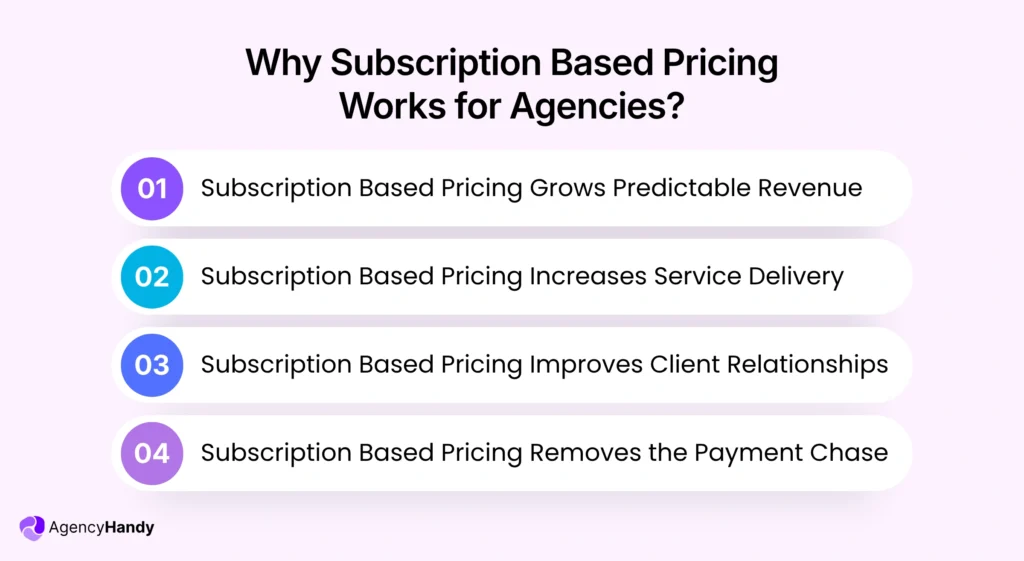
1. Grows Predictable Revenue
Project based billing connects your income to landing the next deal. But when clients pay you every month for your service, your revenue becomes visible and predictable.
You know what’s coming, when it’ll arrive, and what you can do with it. It helps you to plan expenses and make hiring decisions. Most importantly, it lets you invest in the business without waiting for the next signed contract.
2. Makes Service Delivery More Repeatable
With subscription pricing, you don’t need to rely on new clients and complexity for growth. In fact, recurring service packages make the work delivery repeatable. So, you run the same workflow for every client on a tier.
That repeatability becomes much easier to manage when your services are already structured as productized offerings. Read Productized Service Software: Definition, Benefits, Top Software & More to see how that foundation works.
3. Improves Client Relationships
In subscription services, clients hire you for continuous service. They get familiar with your process. Meanwhile, you learn their business. Ultimately, a mutual trust builds over time. Your output quality improves every cycle as you learn the client’s business better.
Thus, a client gets multiple good reasons to stay with you than someone who has just had a single project.
4. Removes the Payment, Chase
According to research by Small Business Insight, US small businesses face a payment delay. On average, they receive their money 8.2 days after it was due.
That shows that invoice chasing is a real problem. But subscription based pricing fixes the issue at its core. Clients agree to a recurring payment schedule upfront. So, you get the bills paid automatically on every cycle.
In return, productized service agencies can manage multiple recurring clients with predictable revenue.
Types of Subscription Based Pricing Models for Agencies
Agencies use four main subscription pricing models. They include flat-rate plans with a fixed scope and price and tiered packages to offer multiple service levels. Lastly, add-on models extend a base plan with optional extras that clients pick each cycle.
So, you should understand each model type to see which one fits your business model.
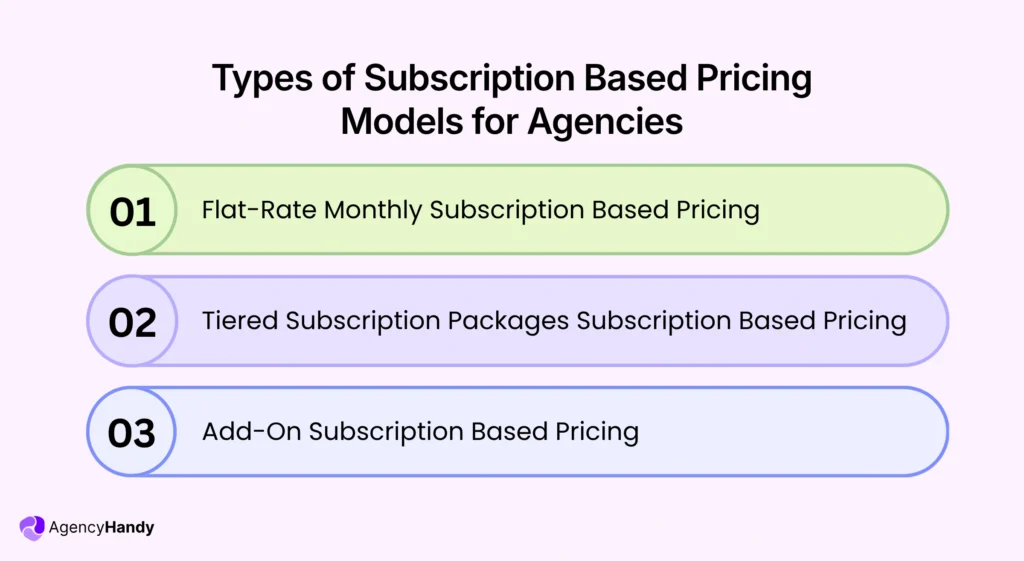
1. Flat-Rate Subscription Based Pricing
Flat rate monthly subscription is the simplest model for productized service agencies. You offer one package at one price. Clients pay one recurring bill every month.
Clients know exactly what they’ll get for their payment. Remember, this model works best if your service has a tight and repeatable scope, such as —
- 8 SEO blog posts per month
- Weekly ad creative production for a defined channel
- Monthly technical SEO audit and reporting package
- Fixed number of design assets
2. Tiered Subscription Packages
Tiered subscription pricing allows agencies to create multiple packages at different prices. Each tier includes a specific service scope. Clients select the tier that fits their budget and needs.
For productized service agencies, three tiers are the right number. When you add more tiers, it makes the client compare your options more than making a decision.
To learn more about building effective service tiers, take a look at Service Packaging – How to Bundle Packages for Clients and Growth?.
3. Add-On Subscription Based Pricing
In the add-on subscription pricing, you keep a fixed base package at the core. Clients subscribe to that core service at first. Later, they pick extra work based on what they need that month.
For example, a productized content agency offers four blog posts at the base. But if the client needs additional posts, they get them as paid add-ons on top.
This way, the core revenue stays as expected per month. Only the add-ons vary per client and per cycle.
4. Agency Retainer Pricing Model
A retainer is a recurring agreement where a client pays a fixed monthly fee for guaranteed access to your time and expertise. It differs from a flat-rate subscription in one key way. And it’s that the client isn’t buying a defined deliverable. They’re reserving your capacity.
This model works well for agencies offering ongoing strategy, consulting, or advisory services where the output varies month to month. You set a monthly fee, define the hours or availability included, and bill on a recurring schedule.
How to Set Up Subscription Based Pricing for Your Agency
Unless you set up the recurring based pricing properly, you won’t get stable revenue. Thus, follow this step-by-step process to set up subscription based pricing for services —
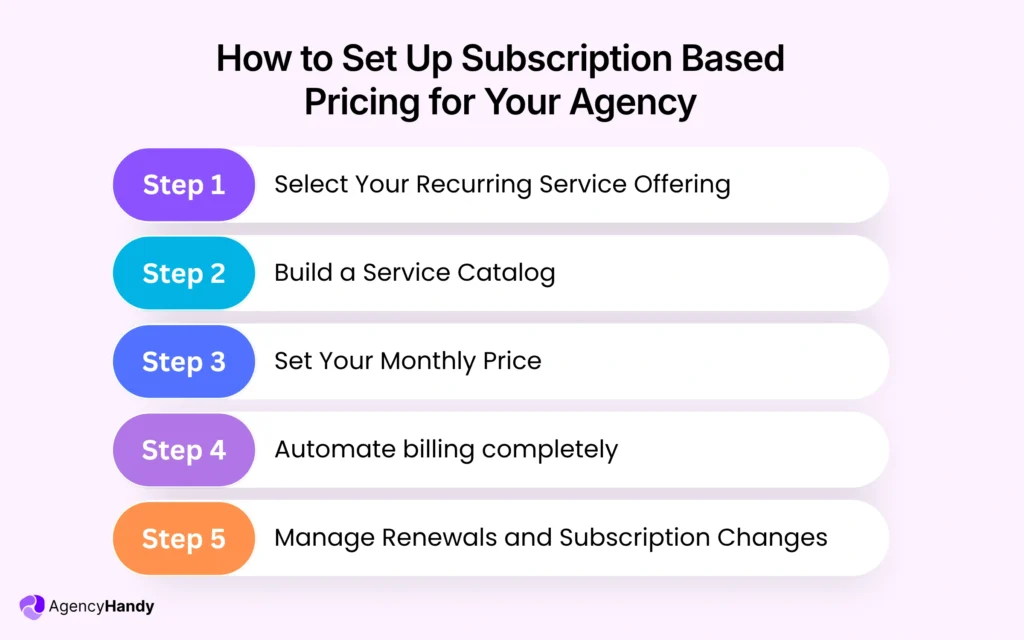
Step 1: Select Your Recurring Service Offering
Pick a service that you can deliver the same way every time. In this case, look at your current services and find one with the most consistent scope, process, and output. Once you get that, define the inclusions, exclusions, and pricing.
Step 2: Build a Service Catalog
A service catalog turns your productized services into a structured menu. It helps clients to browse and buy without back-and-forth.
So, list each service with clear deliverables, a short description, and a fixed price per tier.
Agency Handy’s multi-package service catalog makes this process simple. You can group related services and set prices for each package tier. It also lets you publish the catalog publicly, or you can embed it directly on your website.
Step 3: Set Your Monthly Price
You must set your subscription price above your base cost. To do that, calculate the cost it requires to deliver the service, like —
- Effort
- Time
- Tools
- Overhead, etc.
That number is your floor and never charge below it. Also, measure the outcome your service generates for the client. If you get a strong, measurable result, you can justify a higher price.
A good idea is to research and compare how other productized service agencies are charging for similar packages. For a structured approach to that research, read Service Pricing Guideline for Agencies and Freelancers.
Step 4: Automate Billing Completely
Manual billing is tough to execute when you have a handful of subscription clients. That’s why you should automate the billing cycle. The system should send invoices on time and collect payments without any manual labor.
Agency Handy handles automated billing for agencies. It generates recurring invoices automatically on every billing cycle. Plus, it can send automated reminders for unpaid invoices without your manual input. You just configure once, and your billing runs smoothly.
CTA: Sign up now to automate your subscription billing
Step 5: Manage Renewals and Subscription Changes
Clients upgrade, downgrade, and even cancel subscriptions. So, renewals and plan changes are a normal part of any subscription based pricing model. Here, you must handle each situation properly.
Make an internal system to —
- Track next payment dates
- Expiration timeline
- Plan change request from clients
Keep the information in one place.
Agency Handy’s client portal helps here. It lets clients view their active plan, upcoming renewal dates, and invoice history themselves. That reduces back-and-forth and gives both sides a single reference point. In return, you can keep a stable recurring revenue and decrease the risk of client churn.
Common Mistakes Agencies Make with Subscription Based Pricing
You can offer a free-trial service and then switch to subscription based pricing anytime. To get a full breakdown of how to structure that offer, read Free Trial Services for Agencies: What They Are and How to Offer Them.
However, there are a few mistakes you should be aware of to protect your margins and retain clients.
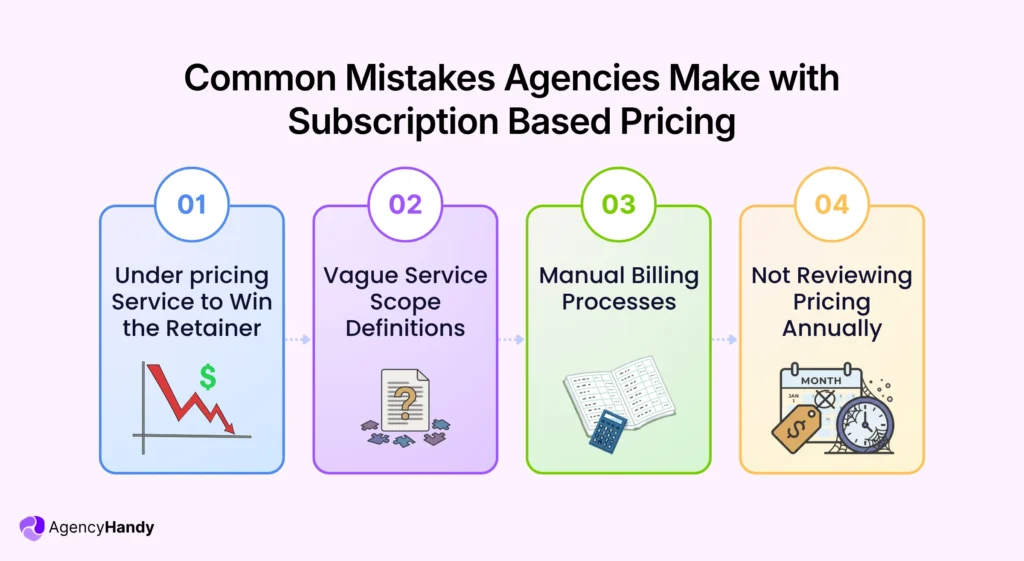
Underpricing Service to Win the Retainer
It initially sounds like a good idea to lower the price of your service to attract clients. But down the line, you start to lose your profit margin, and the cost of operation starts to stack up.
In fact, even if you get a handful of clients, they won’t agree to accept an increased price later.
Vague Service Scope Definitions
A vague service scope is a major mistake that agency owners start to realize fast in subscription based pricing.
If you fail to clearly explain the deliverables, clients start to fill the gap with their own expectations. They start to request beyond the original scope. And before you even notice, you start to deliver more within the same monthly rate.
Manual Billing Processes
Don’t plan to handle subscription billing manually. It’s a critical mistake that you can only feel when it causes serious problems.
Initially, when you have a few clients, it’s manageable. But if it’s 10 clients, for example, you’ll miss to invoice and doing follow-ups. Besides, automated billing removes the chance of human error.
Not Reviewing Pricing Annually
Keeping the subscription price all the time is a great mistake. See —
- Tools subscription increase
- Team salaries grow
- Operation cost increase
So, if your subscription rate remains the same, your profit margin will compress if it doesn’t reach a break-even point. Thus, review your pricing once a year. Calculate the increase in costs and adjust the rate where needed.
How Agency Handy Helps You Manage Subscription Based Pricing
Agency Handy helps you to build and manage your subscription based pricing services from start to finish. Here’s how —
- You can package your services into tiered and repeatable offerings with clear deliverables and pricing.
- It allows you to set what happens at the end of every cycle. You can select “Do Not Create New Order”, “Create New Order without Tasks”, or “Create New Order with Current Tasks”.
- Also, it generates invoices automatically on every cycle without your intervention.
- Plus, you can collect payment through Stripe, PayPal, Wise, manual banking, and cryptocurrency.
- Its reminder templates allow you to send automated payment reminders for unpaid and upcoming renewals.
CTA: Start your free trial and handle subscription-based pricing today!
Final Words
When it comes to ensuring steady recurring revenue, subscription based pricing is the best. But it only works when you have a defined service scope. You should also price the service above the base cost, and your billing system should run on autopilot.
Agency Handy helps you to do everything. You just set up your package with details and set the billing rules. Then, it handles the invoices, payments, reminders, and renewals automatically. And that’s how you grow subscription based pricing service agency.
FAQs
1. What is subscription based pricing for agencies?.
Subscription based pricing is a recurring billing model. A client pays you a fixed monthly fee for continuous service delivery. You don’t charge the client per project. Instead, your agency delivers the same service repeatedly on a set schedule.
2. How do I price a monthly subscription service?
To price a monthly subscription service, start with your base cost. Calculate the real cost to deliver your service every month. Then, add a margin based on the value your client gets from the outcome. Meanwhile, check what similar agencies charge for delivering the same service to stay in the market range.
3. How do I handle subscription cancellations and upgrades?
Handle subscription cancellation with a clear, effective date. It should end at the current billing cycle. Likewise, upgrades in subscription should begin immediately. Also, ensure that you update the next invoice after the client upgrades the subscription. Downgrades work similarly to upgrades.
4. Can agencies offer both one-time and subscription-based pricing?
Yes, agencies can offer both one time and subscription based pricing. Many productized service agencies start with one-time projects and add a subscription tier as the client relationship grows. But you must keep the payment separate in your billing system. Otherwise, the revenue will be mixed up.