


Clients paying late is a common scenario. But you can’t sound pushy. You also can’t let invoices sit unpaid for weeks.
42% of late payments happen due to cash flow, and 36% happen when the process isn’t easy. So, all it takes is to politely ask clients about the payment.
You can send payment reminders manually or automate using software. When you should send reminders is another key factor. When reminders go out at the right time with the right tone, 60% of customers pay on time.
This guide shows you when to send them, what to say, and how to automate everything.
Why Businesses Need to Remind Clients of Payments and Overdues
Most clients don’t refuse to pay invoices. They simply forget. It might be that they are too busy to pay the invoice right now, so scheduled for later. But they eventually forget.
Also, if a particular client gets too many invoices, 10, 20, sometimes 50+, then your invoice might get lost among others. So by the time they remember, it’s already a week overdue.
Payment reminders address this by bringing the invoice back to the client’s attention at strategic moments.
So, sending proper payment reminders at the right time is the key to getting paid without delays.
- A reminder 2 days before the due date prevents it from becoming overdue
- A reminder on the due date might make clients to pay off immediately
- A reminder 3 days after helps clients who genuinely forgot to pay
33% of late payments result from businesses invoicing clients late, according to Atradius. So if you delay sending invoices, your payments will arrive late. It happens a lot with manual invoicing.
But when you automate invoicing, you always send them on time.
How Do Overdue Payments Impact Cashflow and Operations?
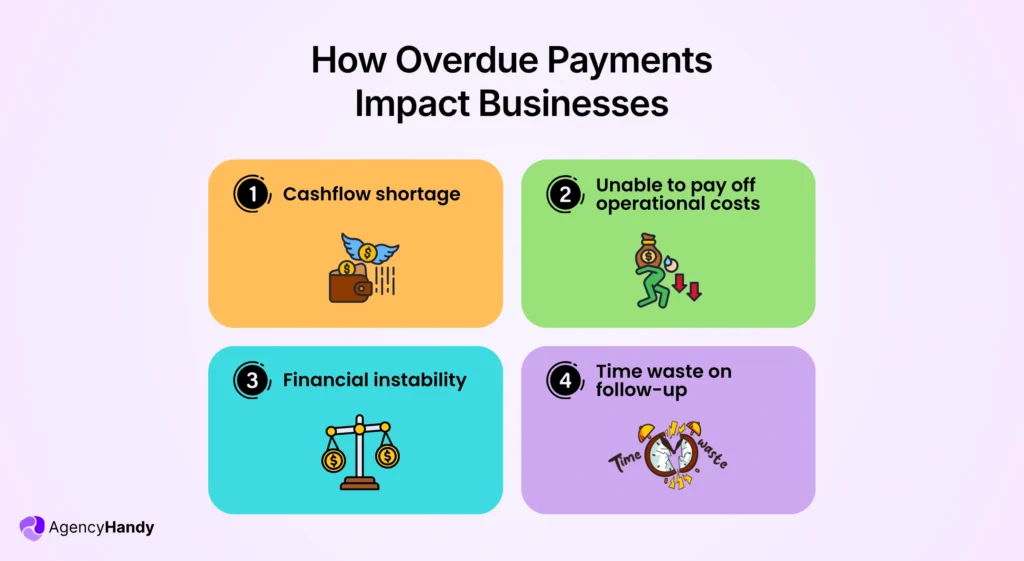
Overdue invoices are one of the reasons for low cash flow. It compounds the effects on operations and other areas. Here’s how overdue invoices affect cash flow in an organization:
Delayed Reminder Causes Overdue Payment
33% of payments arrive late when businesses don’t invoice their clients in time, according to Clockify.
When you send payment reminders, it reminds clients to pay. Your business cash flow becomes stable when you get paid on time. Otherwise, there will be a shortage of cash flow.
Difficult to Pay Off Operational Costs
When clients don’t pay off invoices, you won’t be able to pay off the operational costs. This includes office rent, employee payroll, vendor invoices, and other expenses.
Financial Unstability
32% of businesses lose between 5% and 30% of their annual revenue due to bad debt, according to Creditsafe. When 25% of your clients pay a week late, your agency has to survive with 25% less cash.
And over time, small amounts add up to something significant. This affects hiring decisions, marketing budgets, and reinvestment capacity.
Time Waste on Manual Follow-ups
14% of small to medium-sized businesses waste more than 5 or more hours per week chasing late payments, according to QuickBooks research.
First, you have to send the invoice. Then a follow-up email. If the client doesn’t respond, then send another email a few days later.
If you have 50 clients and need to do this for 20, think about the total working hours required just for this.
When to Send Payment Reminders
Sending your clients payment reminders at the right time is really important. Clients will forget if you send reminders too early. If you send it late, the invoice will be overdue.
Before the Due Date
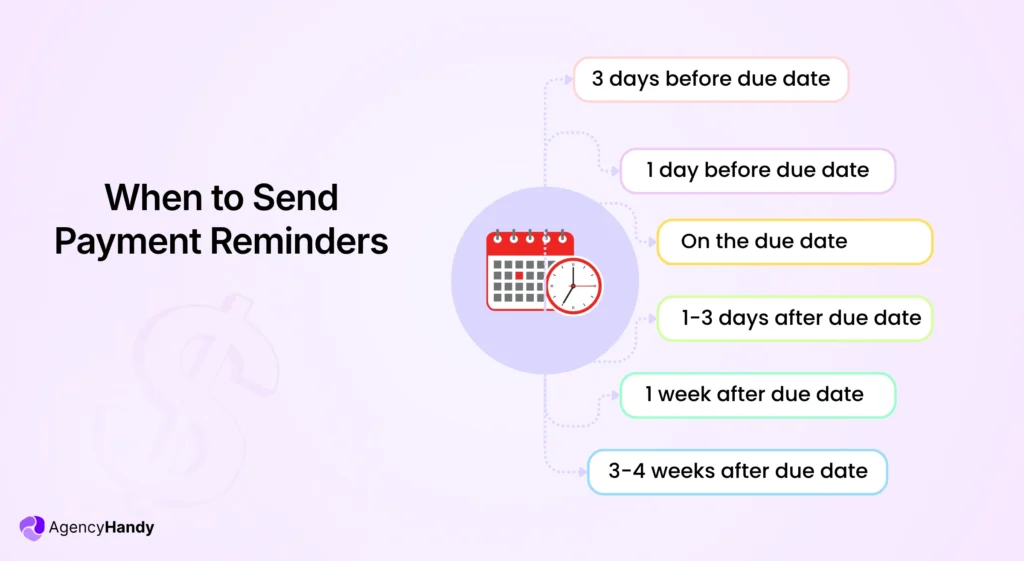
Send the first reminder 3 days before payment is due. This gives clients enough time to approve the payment. If your client has to go through multiple signings for approval, then send it a week before. And then 3 days before the due date.
A second reminder should go out 1 day before the due date. This promptly reminds clients that they have to pay off an invoice within a day.
On the Due Date
Send a reminder on the actual due date. Keep the tone neutral and straightforward. A gentle message, “Your payment of $X is due today.” should do the work. It would create an urgency to pay off the invoice immediately before it is overdue.
After the Due Date
The first overdue notice should go out 1-3 days after the missed deadline. Assume it’s an honest mistake on the client’s part. Your reminder should be polite. But be clear about the overdue status.
If you still don’t get the payment, send a second notice 7 days after the due date. Keep things straightforward this time. Mention any late fee information if applicable as per your contract.
The final notice goes out on the 14th and 30th day after the due date. At this point, make things clear for consequences. It can be like service suspension timelines, escalation to collections, or other actions your business will take as per the contract.
Payment Reminder Email Templates and Overdue Notice Examples
Knowing when to send reminders is half the battle. The other half is knowing what to write. The 9 payment reminder email templates below cover every stage from before the due date to a 30-day overdue final notice.
Just copy, personalize the [bracketed] fields, and send.
Project Delivery Email Template With First Invoice
Send this the moment you wrap up deliverables. It sets a positive tone before payment is even on the table.
Subject: Invoice #[Invoice Number] for [Project Name]
Hi [Client Name],
It’s been a pleasure working with you on [Project Name]. Your feedback along the way made the final deliverable a lot stronger, and I’m looking forward to working together again.
I’ve attached Invoice #[Invoice Number] with this email.
- Total amount: $[Amount]
- Due date: [Due Date]
- Payment options: [PayPal / bank transfer to A/C No. / Pay link]
Feel free to reach out if you need anything clarified.
Best,
[Your Name]
Friendly Payment Reminder Email Template: 3 Days Before Due Date
Subject: Reminder: Invoice #[Invoice Number] due in 3 days
Hi [Client Name],
Quick reminder that Invoice #[Invoice Number] for $[Amount] is due on [Due Date] — 3 days from today.
If it’s already scheduled on your end, please ignore this. Otherwise, you can settle it in a click: [Pay Now]
Best,
[Your Name]
Payment Due Today Email Template
Keep it short and neutral. The job here is to nudge, not pressure.
Subject: Payment due today: Invoice #[Invoice Number]
Hi [Client Name],
Hope you’re doing well. This is a quick reminder that Invoice #[Invoice Number] for $[Amount] is due today.
You can pay via [PayPal / bank transfer / payment link]: [Pay Now]
If the payment is already on the way, no action is needed.
Best,
[Your Name]
First Overdue Payment Reminder Email Template: 1 to 3 Days Late
Assume an honest mistake. Most clients respond best when you give them an easy out.
Subject: Quick check-in on Invoice #[Invoice Number]
Hi [Client Name],
Hope you’re having a good week. I’m following up on Invoice #[Invoice Number] for $[Amount], which was due on [Due Date]. It looks like the payment hasn’t come through yet.
These things happen — likely just slipped through the cracks. You can settle it here: [Pay Now]
If there’s any issue with the invoice or your payment method, please let me know, and I’ll get it fixed right away.
Thanks,
[Your Name]
Overdue Invoice Email Template: 7 Days Past Due
Time to mention late fees if your contract includes them. Stay polite, but be specific.
Subject: Overdue: Invoice #[Invoice Number] — 7 days past due
Hi [Client Name],
I wanted to follow up again on Invoice #[Invoice Number]. It’s now 7 days overdue, and I haven’t heard back on the previous reminder.
- Original due date: [Due Date]
- Amount due: $[Amount]
- [If applicable] Late fee: $[Late Fee Amount]
- Total now owed: $[New Total]
You can complete the payment here: [Pay Now]
I understand things get busy. If you’re running into any trouble settling this, just reply to this email and we can talk through options.
Best, [Your Name]
Late Payment Reminder Email Template: 14 Days Overdue
Tone shifts from “checking in” to “this needs attention.” Still respectful, but the urgency is real.
Subject: Urgent: Invoice #[Invoice Number] is 14 days overdue
Hi [Client Name],
Invoice #[Invoice Number] is now 14 days past due, and I haven’t received a response to the previous reminders.
- Original due date: [Due Date]
- Days overdue: 14
- Outstanding balance (incl. late fees): $[Total]
To keep your account in good standing and avoid any pause in active work, please settle this invoice by [Specific Deadline — e.g., 5 business days from today].
[Pay Now]
If there’s a reason for the delay, please get in touch today and we can find a workable solution — including a payment plan if that helps.
Best, [Your Name]
Final Overdue Notice Email Template: 30 Days Past Due
Firm and concise. Make consequences clear, but leave the door open.
Subject: Final notice: Invoice #[Invoice Number] — Action required by [Date]
Hi [Client Name],
This is a final notice on Invoice #[Invoice Number], now 30 days overdue.
- Original due date: [Due Date]
- Outstanding balance: $[Total including late fees]
If we don’t receive payment by [Final Deadline], we’ll need to take the following steps as outlined in our service agreement:
- Pause all ongoing services and project deliverables
- Forward this account to a collections partner
- [Any other contractual consequence]
We’d much rather resolve this directly. You can pay here: [Pay Now]
Or reply to this email today and we can work out a payment plan that works for both sides.
Best, [Your Name]
Payment Reminder WhatsApp Message Template
If your client communicates over WhatsApp, Slack, or text, a quick message keeps things informal without losing professionalism.
For initial invoice notification:
Hi [Client Name], just a heads-up. I’ve sent Invoice #[Invoice Number] for [Project Name] to your email. Total is $[Amount], due on [Due Date]. Let me know if anything’s unclear!
For overdue follow-ups:
Hi [Client Name], following up on Invoice #[Invoice Number], it’s [X days] overdue now. Could you take a look when you get a chance? Happy to resend the invoice if it got lost.
How to Ask for Overdue Payment Over the Phone
If multiple emails go unanswered, a phone call is your next step. Before you call, have the invoice number, due date, project handover date, and outstanding amount in front of you.
Opening line:
“Hi [Client Name], this is [Your Name]. I worked on [Project Name] a few weeks back. I handed it over on [Date] and sent a few emails about Invoice #[Invoice Number]. I figured those might’ve gotten missed, is that the case?”
Giving the client a face-saving out (“you probably missed them”) removes the awkwardness and opens the conversation up rather than putting them on the defensive.
If they respond positively: Confirm the payment date, thank them, and follow up with a short email summarizing what you agreed.
If they raise an issue: Listen first. Then offer a solution like partial payment, extended timeline, or a payment plan. Keep your tone calm regardless of how the conversation goes.
How Agency Handy Helps to Automate Payment Reminders and Overdue Notices
14% of small to medium-sized businesses spend 5 or more hours weekly chasing late payments, according to QuickBooks research. Agency Handy automates the reminder sending sequences. This significantly saves your business both time and resources.
Here’s how the platform helps send automated payment reminders:
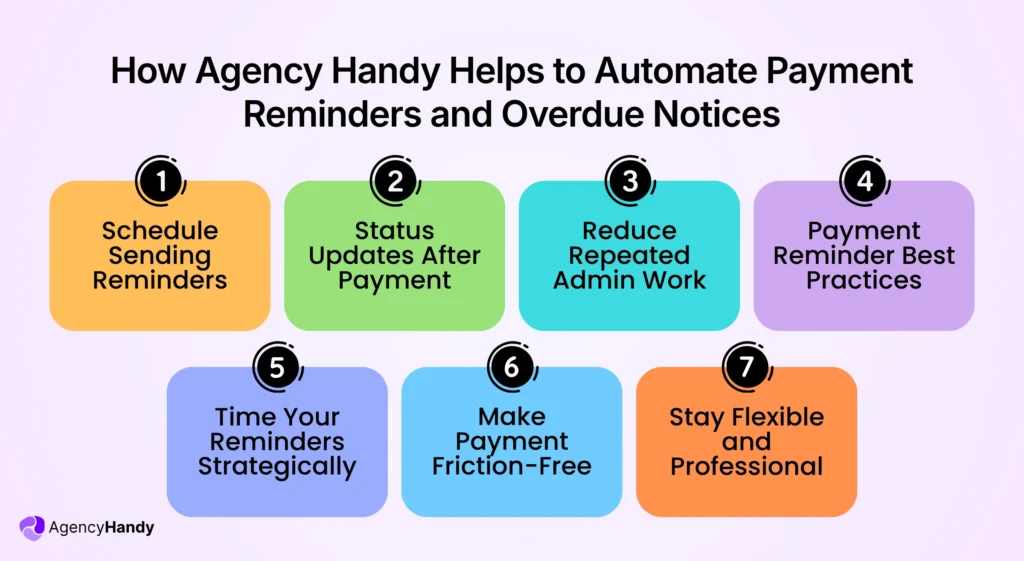
Schedule Sending Reminders
Configure when reminders should go out. It can be 7 days before the due date, on the due date, 3 days overdue, 7 days overdue. Or whatever you prefer. Agency Handy will send reminders automatically. The system runs in the background while you work on billable projects.
Status Updates After Payment
The moment a client pays, Agency Handy won’t send reminders when a client pays off the invoice. The tool maintains an integration between invoices and reminders. It keeps everything synchronized.
Reduce Repeated Admin Work
Agency Handy handles the administrative work of payment collection. It automates the entire process. This alone saves your team 5+ hours per week.
Payment Reminder Best Practices
60% of customers pay on time when they receive a well-structured reminder, according to industry research. All you have to do is to make it easier for clients. Reduce as much friction as possible.
Include These Details in Every Reminder
- Invoice number
- Exact amount due
- Original due date for reference
- Direct payment link or clear instructions on how to pay
- Contact person if they have questions
Time Your Reminders Strategically
- Send first reminder 7 days before the due date
- Send second reminder on the actual due date
- Keep the tone friendly and helpful, not demanding
Make Payment Friction-Free
- Provide clickable payment links in every email
- Offer multiple payment options (cards, bank transfer, digital wallets)
- Make reminders friendly for mobile viewing
Stay Flexible and Professional
- Respond quickly when clients have questions
- Consider payment plans if clients have temporary cash flow issues
- Offer early payment discounts (2-5%) to encourage faster payment
- Use automation but keep messages personalized
Frequently Asked Questions
How to set reminders for payments?
Schedule reminders 3 days before due date, 1 day before, on due date, and 3, 7, 14 days after if overdue. You can use calendar alerts or invoicing software to automate the timing.
How to automate a payment reminder?
Use invoicing software like Agency Handy to set up reminder sequences once. The system sends emails automatically at scheduled intervals and stops when payment is received.
What should I do if a client says they never received the invoice?
Resend the invoice immediately and confirm receipt. Check if it went to spam. Consider using invoice tracking tools to verify delivery in the future.
Should I charge interest on overdue invoices?
Yes, if stated in your contract upfront. Typical rates are 1-2% monthly. Check your state’s laws as some limit maximum interest rates on late payments.
Can I stop work if payment is overdue?
Yes, if your contract allows it. Notify the client professionally that work pauses until payment clears. This protects your business from further unpaid work.
What payment terms should I set for my invoices?
Net 15 or Net 30 are standard. Shorter terms (Net 7) work for small projects. Longer terms (Net 60) may be necessary for large corporate clients with rigid payment processes.
Final Words
It’s better to think about building a system to reduce late payments. You should set clear expectations when you onboard clients. Make paying you ridiculously easy for clients. Most importantly, automate your payment reminder sequences. So you don’t have to manually track due dates and send follow-up emails.